PET 2026 · History
Read rulers through their historical sources ऐतिहासिक स्रोत और प्रमुख शासक Connect Mauryan, Gupta, Pushyabhuti and Ghaznavid-era accounts to their authors and polities मौर्य, गुप्त, पुष्यभूति और ग़ज़नवी काल के ऐतिहासिक विवरणों का उनके लेखकों और राज्यों से संबंध
◈
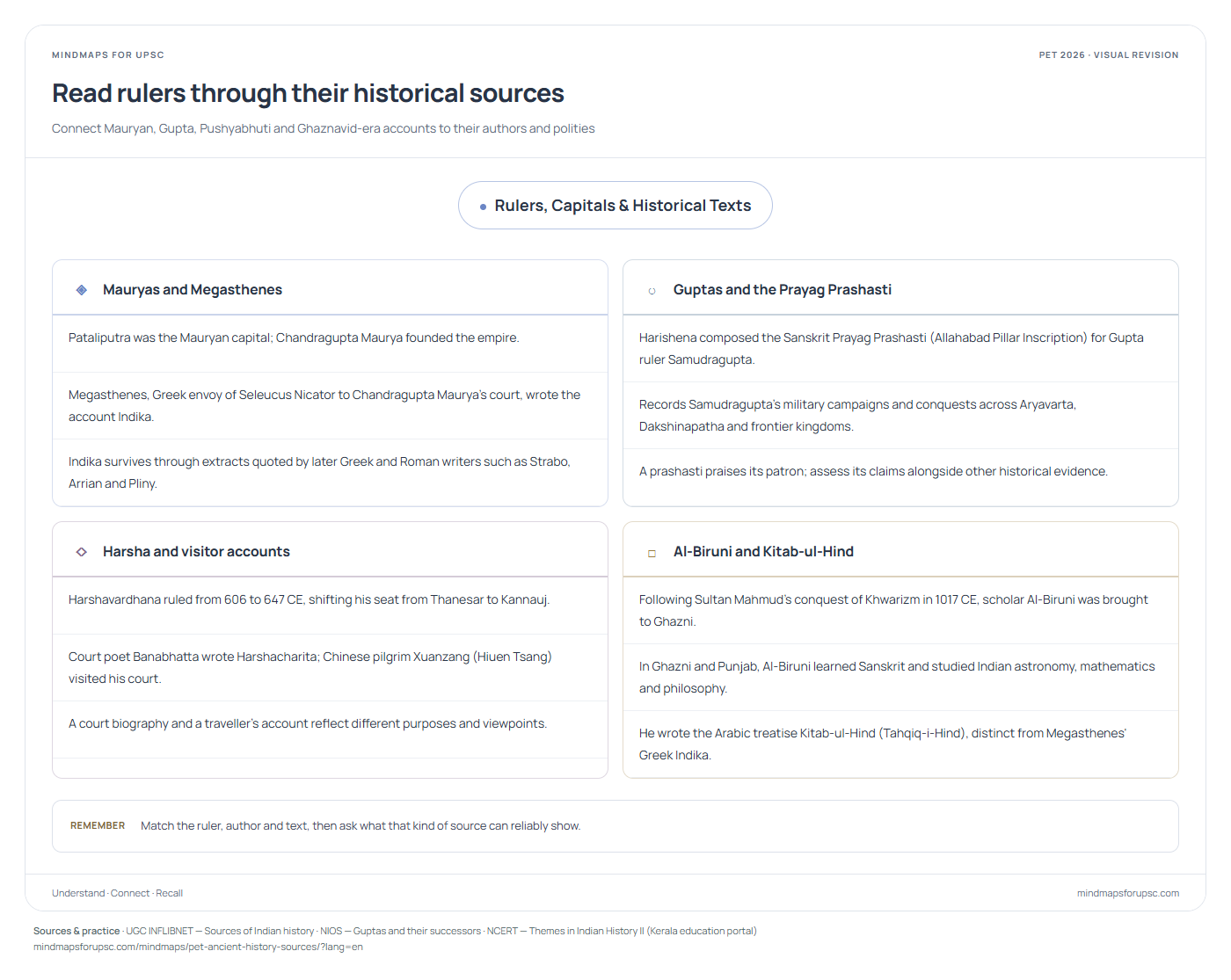
Mauryas and Megasthenes
Pataliputra was the Mauryan capital; Chandragupta Maurya founded the empire. Megasthenes, Greek envoy of Seleucus Nicator to Chandragupta Maurya's court, wrote the account Indika. Indika survives through extracts quoted by later Greek and Roman writers such as Strabo, Arrian and Pliny.
○
Guptas and the Prayag Prashasti
Harishena composed the Sanskrit Prayag Prashasti (Allahabad Pillar Inscription) for Gupta ruler Samudragupta. Records Samudragupta's military campaigns and conquests across Aryavarta, Dakshinapatha and frontier kingdoms. A prashasti praises its patron; assess its claims alongside other historical evidence.
◇
Harsha and visitor accounts
Harshavardhana ruled from 606 to 647 CE, shifting his seat from Thanesar to Kannauj. Court poet Banabhatta wrote Harshacharita; Chinese pilgrim Xuanzang (Hiuen Tsang) visited his court. A court biography and a traveller’s account reflect different purposes and viewpoints.
□
Al-Biruni and Kitab-ul-Hind
Following Sultan Mahmud's conquest of Khwarizm in 1017 CE, scholar Al-Biruni was brought to Ghazni. In Ghazni and Punjab, Al-Biruni learned Sanskrit and studied Indian astronomy, mathematics and philosophy. He wrote the Arabic treatise Kitab-ul-Hind (Tahqiq-i-Hind), distinct from Megasthenes' Greek Indika. Remember Match the ruler, author and text, then ask what that kind of source can reliably show.
◈
मौर्य और मेगस्थनीज
पाटलिपुत्र मौर्य राजधानी थी; चंद्रगुप्त मौर्य ने साम्राज्य की स्थापना की। चंद्रगुप्त मौर्य के दरबार में सेल्यूकस निकेटर के यूनानी राजदूत मेगस्थनीज ने 'इंडिका' नामक ग्रंथ लिखा। 'इंडिका' मूल रूप में उपलब्ध नहीं है, बल्कि स्ट्रैबो, एरियन और प्लिनी जैसे परवर्ती लेखकों के उद्धरणों में सुरक्षित है।
○
गुप्त और प्रयाग प्रशस्ति
राजकवि हरिषेण ने गुप्त सम्राट समुद्रगुप्त के लिए संस्कृत में 'प्रयाग प्रशस्ति' (इलाहाबाद स्तंभ अभिलेख) की रचना की। इसमें आर्यावर्त, दक्षिणापथ और सीमांत राज्यों में समुद्रगुप्त के सैन्य अभियानों और विजयों का विस्तृत विवरण है। प्रशस्ति अपने आश्रयदाता की प्रशंसा करती है; उसके दावों को अन्य ऐतिहासिक साक्ष्यों के साथ परखें।
◇
हर्ष और यात्री-वृत्तांत
हर्षवर्धन ने 606 से 647 ईस्वी तक शासन किया और अपनी राजधानी थानेसर से कन्नौज स्थानांतरित की। दरबारी कवि बाणभट्ट ने 'हर्षचरित' लिखा तथा चीनी यात्री ह्वेनसांग (युआन च्वांग) ने उनके दरबार की यात्रा की। दरबारी जीवनी और यात्री-वृत्तांत के उद्देश्य तथा दृष्टिकोण अलग हो सकते हैं।
□
अल-बिरूनी और किताब-उल-हिंद
1017 ईस्वी में सुल्तान महमूद की ख़्वारिज़्म विजय के बाद विद्वान अल-बिरूनी को ग़ज़नी लाया गया था। ग़ज़नी और पंजाब में रहकर अल-बिरूनी ने संस्कृत सीखी तथा भारतीय खगोलशास्त्र, गणित और दर्शन का अध्ययन किया। उन्होंने अरबी में 'किताब-उल-हिंद' (तहकीक-ए-हिंद) की रचना की, जो मेगस्थनीज की यूनानी 'इंडिका' से भिन्न है। याद रखें शासक, लेखक और ग्रंथ का मिलान करें; फिर समझें कि उस प्रकार का स्रोत क्या विश्वसनीय जानकारी देता है।
Practise this concept · संबंधित प्रश्न One visual, several questions. These links open the original paper at the matching question.
Sources & study notes · स्रोत Independent revision material, linked to the paper’s concepts. The question papers and answer-key status are available on OpenPYQ.