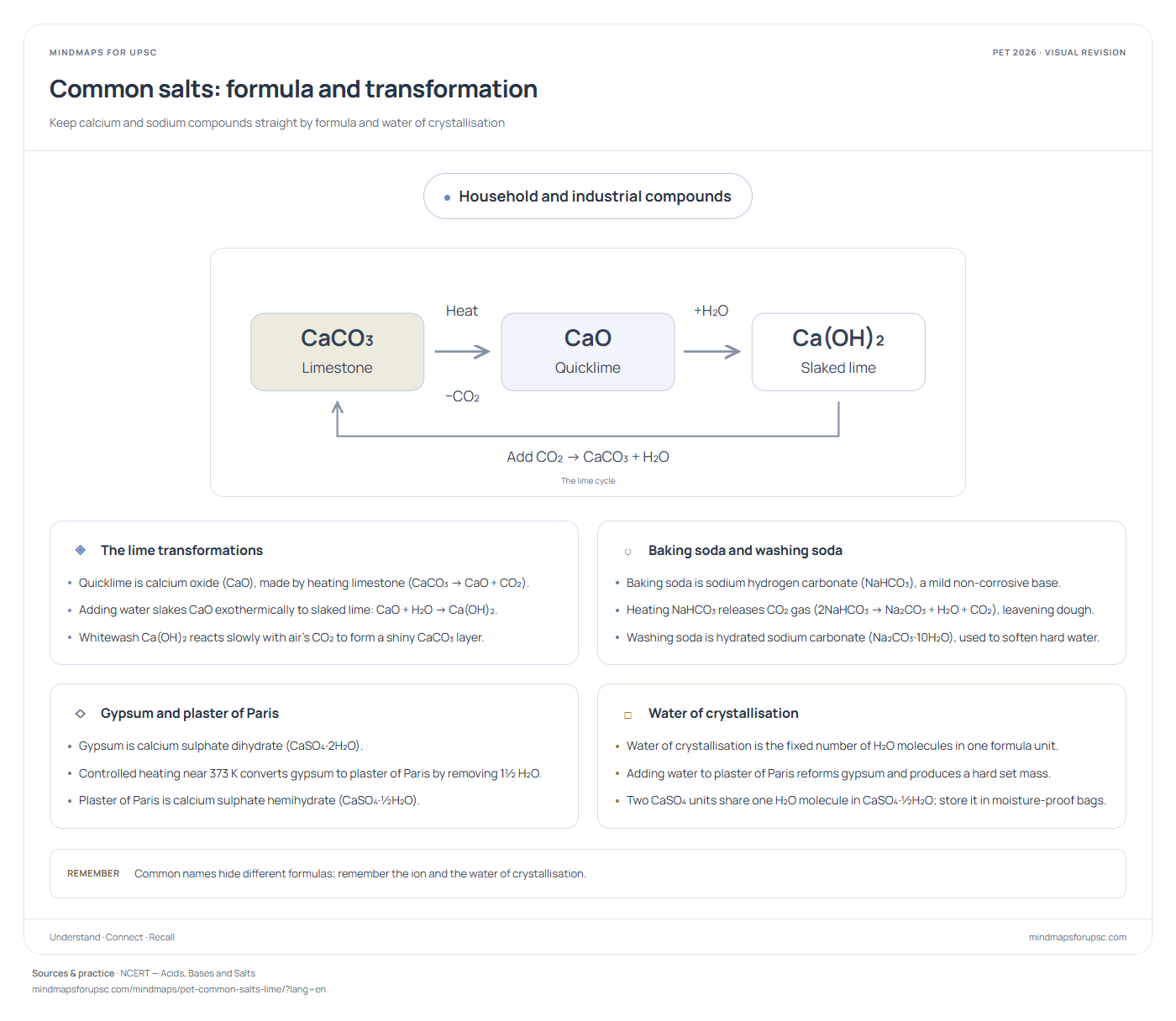
The lime cycle CaCO₃ Limestone CaO Quicklime Ca(OH)₂ Slaked lime Heat −CO₂ +H₂O Add CO₂ → CaCO₃ + H₂O The lime cycleSwipe sideways to explore the diagram.
◈
The lime transformations
Quicklime is calcium oxide (CaO), made by heating limestone (CaCO₃ → CaO + CO₂). Adding water slakes CaO exothermically to slaked lime: CaO + H₂O → Ca(OH)₂. Whitewash Ca(OH)₂ reacts slowly with air's CO₂ to form a shiny CaCO₃ layer.
○
Baking soda and washing soda
Baking soda is sodium hydrogen carbonate (NaHCO₃), a mild non-corrosive base. Heating NaHCO₃ releases CO₂ gas (2NaHCO₃ → Na₂CO₃ + H₂O + CO₂), leavening dough. Washing soda is hydrated sodium carbonate (Na₂CO₃·10H₂O), used to soften hard water.
◇
Gypsum and plaster of Paris
Gypsum is calcium sulphate dihydrate (CaSO₄·2H₂O). Controlled heating near 373 K converts gypsum to plaster of Paris by removing 1½ H₂O. Plaster of Paris is calcium sulphate hemihydrate (CaSO₄·½H₂O).
□
Water of crystallisation
Water of crystallisation is the fixed number of H₂O molecules in one formula unit. Adding water to plaster of Paris reforms gypsum and produces a hard set mass. Two CaSO₄ units share one H₂O molecule in CaSO₄·½H₂O; store it in moisture-proof bags.
चूना चक्र CaCO₃ चूना पत्थर CaO बिना बुझा चूना Ca(OH)₂ बुझा हुआ चूना ऊष्मा −CO₂ +H₂O CO₂ मिलाएँ → CaCO₃ + H₂O चूना चक्रआरेख देखने के लिए दाएँ-बाएँ खिसकाएँ।
◈
चूने के रूपांतरण
बिना बुझा चूना (क्विकलाइम) कैल्शियम ऑक्साइड (CaO) है, जो चूना पत्थर (CaCO₃) को गर्म करने पर बनता है। जल मिलाने पर CaO ऊष्माक्षेपी अभिक्रिया द्वारा बुझे हुए चूने में बदलता है: CaO + H₂O → Ca(OH)₂। सफेदी में प्रयुक्त Ca(OH)₂ वायु की CO₂ से धीमी अभिक्रिया कर दीवारों पर CaCO₃ की चमकदार परत बनाता है।
○
बेकिंग सोडा और धावन सोडा
बेकिंग सोडा (खाने का सोडा) सोडियम हाइड्रोजन कार्बोनेट या सोडियम बाइकार्बोनेट (NaHCO₃) है। गर्म करने पर NaHCO₃ से CO₂ गैस निकलती है (2NaHCO₃ → Na₂CO₃ + H₂O + CO₂), जो खाद्य पदार्थों को स्पंजी बनाती है। वाशिंग (धावन) सोडा सोडियम कार्बोनेट डेकाहाइड्रेट (Na₂CO₃·10H₂O) है, जो जल की स्थायी कठोरता दूर करता है।
◇
जिप्सम और प्लास्टर ऑफ पेरिस
जिप्सम का रासायनिक नाम कैल्शियम सल्फेट डाइहाइड्रेट और सूत्र CaSO₄·2H₂O है। लगभग 373 K पर नियंत्रित तापन से जिप्सम 1½ H₂O खोकर प्लास्टर ऑफ पेरिस बनता है। प्लास्टर ऑफ पेरिस कैल्शियम सल्फेट हेमीहाइड्रेट (CaSO₄·½H₂O) है।
□
क्रिस्टलन का जल
किसी लवण के एक सूत्र इकाई में जुड़े जल के निश्चित अणुओं की संख्या को 'क्रिस्टलन का जल' कहते हैं। प्लास्टर ऑफ पेरिस में जल मिलाने से फिर जिप्सम बनता है और द्रव्यमान कठोर हो जाता है। CaSO₄·½H₂O में दो CaSO₄ इकाइयाँ जल के एक अणु को साझा करती हैं; इसे नमी-रोधी पात्र में रखा जाता है।
Practise this concept · संबंधित प्रश्न One visual, several questions. These links open the original paper at the matching question.
Sources & study notes · स्रोत Independent revision material, linked to the paper’s concepts. The question papers and answer-key status are available on OpenPYQ.