PET 2026 · History
Mass movements: keep the turning points straight जन आंदोलन: राष्ट्रीय आंदोलन के प्रमुख मोड़ Chronological sequence of pacts, repressive acts, mass satyagrahas and withdrawals (1916–1942) समझौतों, दमनकारी कानूनों, जन सत्याग्रहों और आंदोलन वापसी का कालानुक्रम (1916–1942)
01
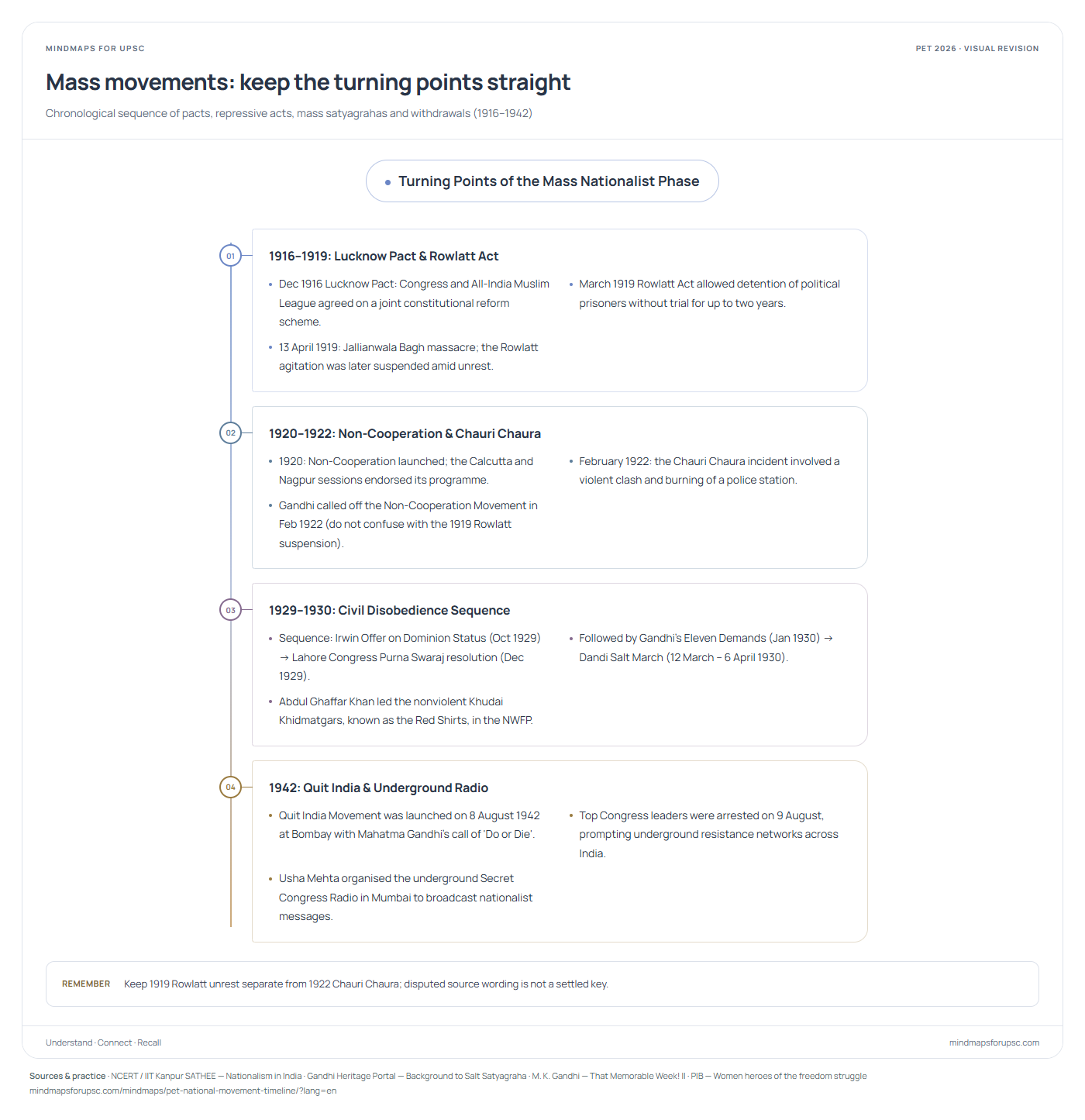
1916–1919: Lucknow Pact & Rowlatt Act
Dec 1916 Lucknow Pact: Congress and All-India Muslim League agreed on a joint constitutional reform scheme. March 1919 Rowlatt Act allowed detention of political prisoners without trial for up to two years. 13 April 1919: Jallianwala Bagh massacre; the Rowlatt agitation was later suspended amid unrest.
02
1920–1922: Non-Cooperation & Chauri Chaura
1920: Non-Cooperation launched; the Calcutta and Nagpur sessions endorsed its programme. February 1922: the Chauri Chaura incident involved a violent clash and burning of a police station. Gandhi called off the Non-Cooperation Movement in Feb 1922 (do not confuse with the 1919 Rowlatt suspension).
03
1929–1930: Civil Disobedience Sequence
Sequence: Irwin Offer on Dominion Status (Oct 1929) → Lahore Congress Purna Swaraj resolution (Dec 1929). Followed by Gandhi's Eleven Demands (Jan 1930) → Dandi Salt March (12 March – 6 April 1930). Abdul Ghaffar Khan led the nonviolent Khudai Khidmatgars, known as the Red Shirts, in the NWFP.
04
1942: Quit India & Underground Radio
Quit India Movement was launched on 8 August 1942 at Bombay with Mahatma Gandhi's call of 'Do or Die'. Top Congress leaders were arrested on 9 August, prompting underground resistance networks across India. Usha Mehta organised the underground Secret Congress Radio in Mumbai to broadcast nationalist messages. Remember Keep 1919 Rowlatt unrest separate from 1922 Chauri Chaura; disputed source wording is not a settled key.
01
1916–1919: लखनऊ समझौता एवं रॉलेट एक्ट
दिसंबर 1916 का लखनऊ समझौता: काँग्रेस और अखिल भारतीय मुस्लिम लीग संयुक्त संवैधानिक सुधारों पर सहमत हुए। मार्च 1919 के रॉलेट अधिनियम ने राजनीतिक कैदियों को बिना मुकदमे के दो वर्ष तक हिरासत में रखने की अनुमति दी। 13 अप्रैल 1919: जलियाँवाला बाग हत्याकांड; अशांति के बीच रॉलेट आंदोलन बाद में स्थगित हुआ।
02
1920–1922: असहयोग आंदोलन एवं चौरी-चौरा
1920: असहयोग आंदोलन का आरंभ; कलकत्ता और नागपुर अधिवेशनों ने इसके कार्यक्रम को स्वीकृति दी। फरवरी 1922: चौरी-चौरा में हिंसक झड़प हुई और थाने में आग लगा दी गई। गाँधीजी ने फरवरी 1922 में असहयोग आंदोलन वापस ले लिया (इसे 1919 के रॉलेट सत्याग्रह स्थगन से भ्रमित न करें)।
03
1929–1930: सविनय अवज्ञा का घटनाक्रम
क्रम: डोमिनियन स्टेटस पर इरविन घोषणा (अक्टूबर 1929) → लाहौर काँग्रेस में पूर्ण स्वराज प्रस्ताव (दिसंबर 1929)। इसके बाद गाँधीजी की ग्यारह माँगें (जनवरी 1930) → दांडी नमक यात्रा (12 मार्च – 6 अप्रैल 1930) हुई। अब्दुल गफ़्फ़ार ख़ान ने उत्तर-पश्चिम सीमांत प्रांत में अहिंसक ख़ुदाई ख़िदमतगार या ‘लाल कुर्ती’ आंदोलन चलाया।
04
1942: भारत छोड़ो एवं भूमिगत रेडियो
8 अगस्त 1942 को मुंबई में महात्मा गाँधी के 'करो या मरो' के आह्वान के साथ भारत छोड़ो आंदोलन शुरू हुआ। 9 अगस्त को शीर्ष नेताओं की गिरफ्तारी के बाद देश भर में भूमिगत प्रतिरोध नेटवर्क सक्रिय हो गए। उषा मेहता ने राष्ट्रवादी संदेश प्रसारित करने के लिए मुंबई में भूमिगत गुप्त काँग्रेस रेडियो का संचालन किया। याद रखें 1919 की रॉलेट अशांति और 1922 के चौरी-चौरा को अलग रखें; विवादित प्रश्न की भाषा को निश्चित उत्तर-कुंजी न मानें।
Practise this concept · संबंधित प्रश्न One visual, several questions. These links open the original paper at the matching question.
Sources & study notes · स्रोत Independent revision material, linked to the paper’s concepts. The question papers and answer-key status are available on OpenPYQ.