PET 2026 · Polity
Rights, Directive Principles and Duties मौलिक अधिकार, नीति निदेशक तत्त्व और मौलिक कर्तव्य Compare constitutional location, enforceability and key articles across Parts III, IV and IVA भाग III, IV और IVA के संवैधानिक स्थान, प्रवर्तनीयता और प्रमुख अनुच्छेदों की तुलना
◈
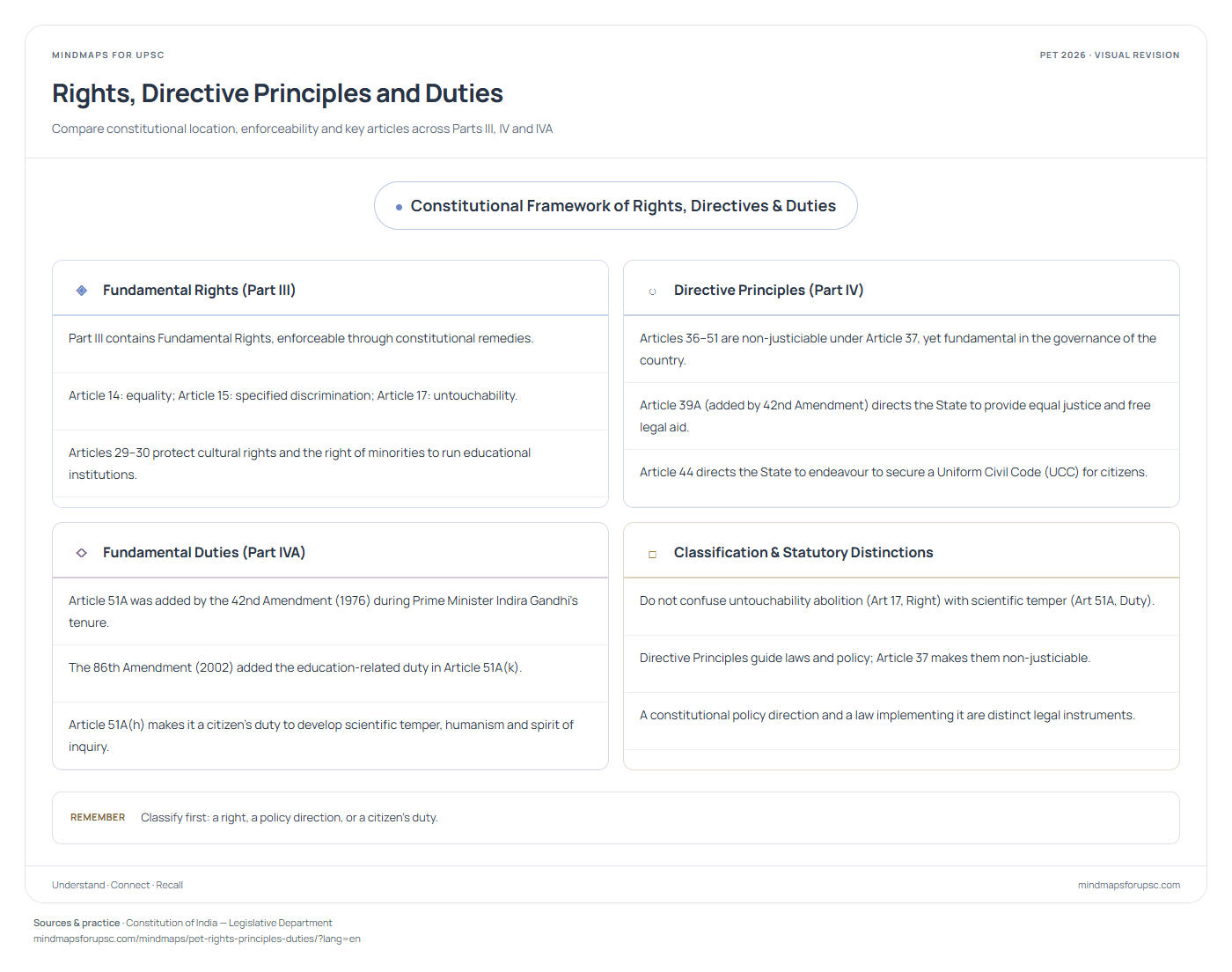
Fundamental Rights (Part III)
Part III contains Fundamental Rights, enforceable through constitutional remedies. Article 14: equality; Article 15: specified discrimination; Article 17: untouchability. Articles 29–30 protect cultural rights and the right of minorities to run educational institutions.
○
Directive Principles (Part IV)
Articles 36–51 are non-justiciable under Article 37, yet fundamental in the governance of the country. Article 39A (added by 42nd Amendment) directs the State to provide equal justice and free legal aid. Article 44 directs the State to endeavour to secure a Uniform Civil Code (UCC) for citizens.
◇
Fundamental Duties (Part IVA)
Article 51A was added by the 42nd Amendment (1976) during Prime Minister Indira Gandhi's tenure. The 86th Amendment (2002) added the education-related duty in Article 51A(k). Article 51A(h) makes it a citizen's duty to develop scientific temper, humanism and spirit of inquiry.
□
Classification & Statutory Distinctions
Do not confuse untouchability abolition (Art 17, Right) with scientific temper (Art 51A, Duty). Directive Principles guide laws and policy; Article 37 makes them non-justiciable. A constitutional policy direction and a law implementing it are distinct legal instruments. Remember Classify first: a right, a policy direction, or a citizen’s duty.
◈
मौलिक अधिकार (भाग III)
भाग III के मौलिक अधिकारों को संवैधानिक उपचारों द्वारा प्रवर्तित कराया जा सकता है। अनुच्छेद 14: समता; 15: निर्दिष्ट आधारों पर भेदभाव का निषेध; 17: अस्पृश्यता का अंत। अनुच्छेद 29–30 सांस्कृतिक अधिकारों और अल्पसंख्यकों के शिक्षण संस्थान चलाने के अधिकार का संरक्षण करते हैं।
○
राज्य के नीति निदेशक तत्त्व (भाग IV)
अनुच्छेद 36–51 अनुच्छेद 37 के तहत न्यायालय द्वारा अप्रवर्तनीय हैं, किंतु देश के शासन में मूलभूत हैं। अनुच्छेद 39क (42वें संशोधन द्वारा जोड़ा गया) राज्य को समान न्याय और निःशुल्क विधिक सहायता का निर्देश देता है। अनुच्छेद 44 राज्य को नागरिकों के लिए समान नागरिक संहिता (UCC) लागू करने का प्रयास करने का निर्देश देता है।
◇
मौलिक कर्तव्य (भाग IVA)
अनुच्छेद 51क को प्रधानमंत्री इंदिरा गाँधी के कार्यकाल में 42वें संशोधन (1976) द्वारा जोड़ा गया था। 86वें संशोधन (2002) ने अनुच्छेद 51क(ट) में शिक्षा-संबंधी कर्तव्य जोड़ा। अनुच्छेद 51क(ज) वैज्ञानिक दृष्टिकोण, मानववाद और ज्ञानार्जन की भावना का विकास नागरिक का कर्तव्य बनाता है।
□
वर्गीकरण एवं वैधानिक विभेद
अस्पृश्यता उन्मूलन (अनुच्छेद 17, अधिकार) को वैज्ञानिक दृष्टिकोण (अनुच्छेद 51क, कर्तव्य) से भ्रमित न करें। नीति निदेशक तत्त्व कानून और नीति का मार्गदर्शन करते हैं; अनुच्छेद 37 इन्हें न्यायालय से अप्रवर्तनीय बनाता है। संवैधानिक नीति-निर्देश और उसे लागू करने वाला कानून अलग विधिक प्रावधान हैं। याद रखें पहले पहचानें: मौलिक अधिकार, राज्य के लिए नीति-निर्देश या नागरिक का कर्तव्य।
Practise this concept · संबंधित प्रश्न One visual, several questions. These links open the original paper at the matching question.
Sources & study notes · स्रोत Independent revision material, linked to the paper’s concepts. The question papers and answer-key status are available on OpenPYQ.