PET 2026 · CSAT
Pie charts: angle, share and count पाई चार्ट: केंद्रीय कोण, प्रतिशत अंश और संख्या Convert between 360° angles, 100% shares and actual counts across single or dual pie charts एकल या द्वि-पाई चार्ट में 360° केंद्रीय कोण, 100% अंश और वास्तविक संख्याओं के बीच रूपांतरण
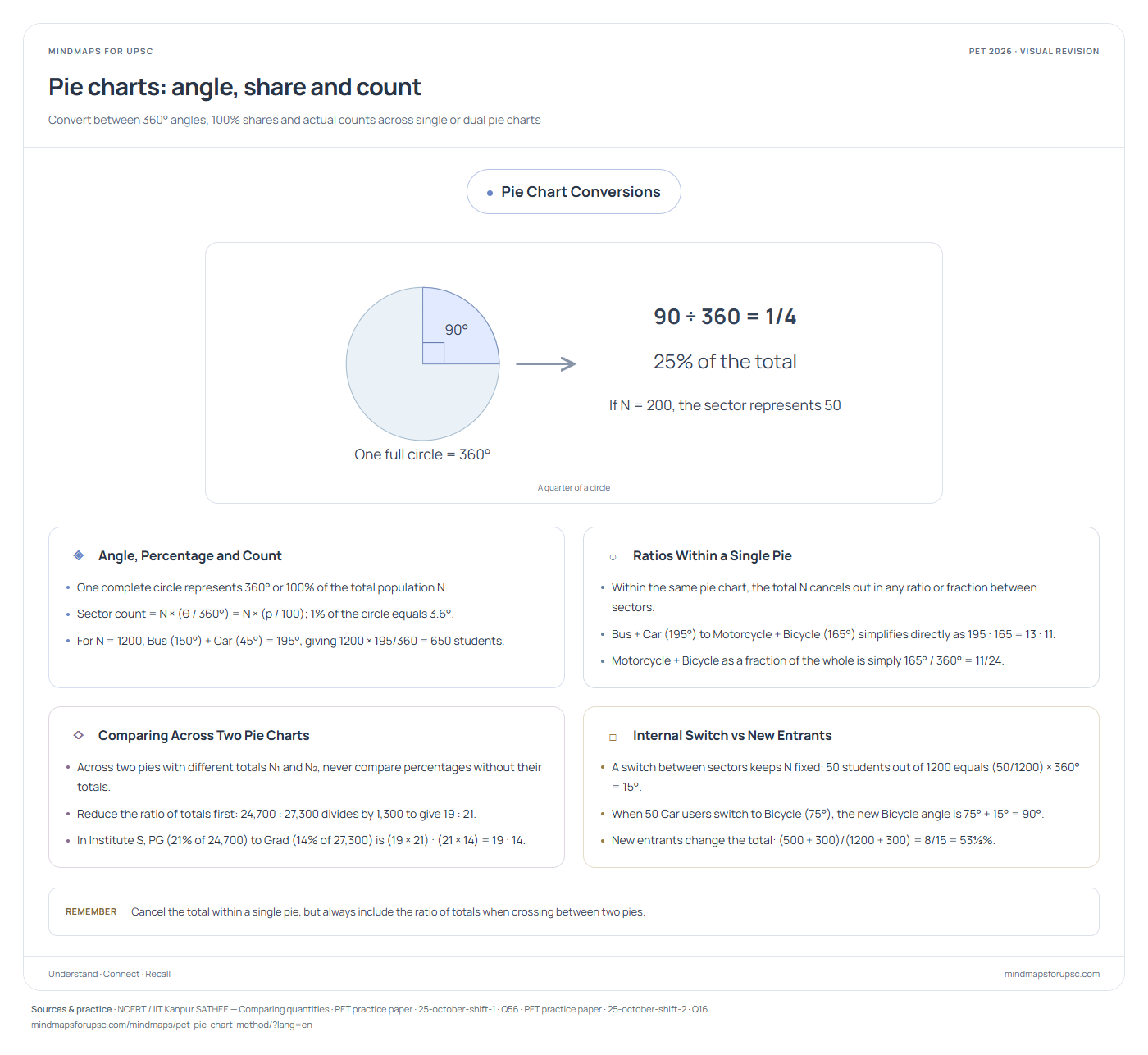
A quarter of a circle 90° One full circle = 360° 90 ÷ 360 = 1/4 25% of the total If N = 200, the sector represents 50 A quarter of a circleSwipe sideways to explore the diagram.
◈
Angle, Percentage and Count
One complete circle represents 360° or 100% of the total population N. Sector count = N × (θ / 360°) = N × (p / 100); 1% of the circle equals 3.6°. For N = 1200, Bus (150°) + Car (45°) = 195°, giving 1200 × 195/360 = 650 students.
○
Ratios Within a Single Pie
Within the same pie chart, the total N cancels out in any ratio or fraction between sectors. Bus + Car (195°) to Motorcycle + Bicycle (165°) simplifies directly as 195 : 165 = 13 : 11. Motorcycle + Bicycle as a fraction of the whole is simply 165° / 360° = 11/24.
◇
Comparing Across Two Pie Charts
Across two pies with different totals N₁ and N₂, never compare percentages without their totals. Reduce the ratio of totals first: 24,700 : 27,300 divides by 1,300 to give 19 : 21. In Institute S, PG (21% of 24,700) to Grad (14% of 27,300) is (19 × 21) : (21 × 14) = 19 : 14.
□
Internal Switch vs New Entrants
A switch between sectors keeps N fixed: 50 students out of 1200 equals (50/1200) × 360° = 15°. When 50 Car users switch to Bicycle (75°), the new Bicycle angle is 75° + 15° = 90°. New entrants change the total: (500 + 300)/(1200 + 300) = 8/15 = 53⅓%. Remember Cancel the total within a single pie, but always include the ratio of totals when crossing between two pies.
वृत्त का एक चौथाई भाग 90° पूरा वृत्त = 360° 90 ÷ 360 = 1/4 कुल का 25% यदि N = 200, तो यह खंड 50 दर्शाता है वृत्त का एक चौथाई भागआरेख देखने के लिए दाएँ-बाएँ खिसकाएँ।
◈
कोण, प्रतिशत और वास्तविक संख्या
एक पूर्ण वृत्त कुल संख्या N के 360° केंद्रीय कोण या 100% अंश को दर्शाता है। त्रिज्यखंड की संख्या = N × (θ / 360°) = N × (p / 100); वृत्त का 1% अंश 3.6° के बराबर होता है। N = 1200 के लिए, बस (150°) + कार (45°) = 195°, जिससे 1200 × 195/360 = 650 छात्र मिलते हैं।
○
एक ही पाई चार्ट के भीतर अनुपात
एक ही पाई चार्ट के दो भागों के अनुपात या भिन्न में कुल संख्या N कट जाती है। बस + कार (195°) और मोटरसाइकिल + साइकिल (165°) का अनुपात सीधे 195 : 165 = 13 : 11 हो जाता है। कुल छात्रों में मोटरसाइकिल और साइकिल का अंश सीधे कोणों से 165° / 360° = 11/24 निकलता है।
◇
दो अलग पाई चार्टों के बीच तुलना
भिन्न कुल मान N₁ और N₂ वाले दो पाई चार्टों में कुल संख्या लिए बिना केवल प्रतिशतों की तुलना न करें। पहले दोनों कुल मानों का अनुपात सरल करें: 24,700 : 27,300 को 1,300 से भाग देने पर 19 : 21 मिलता है। संस्थान S में स्नातकोत्तर (21%) और स्नातक (14%) का अनुपात सीधे (19 × 21) : (21 × 14) = 19 : 14 होगा।
□
आंतरिक स्थानांतरण बनाम नए प्रवेश
जब छात्र एक साधन से दूसरे में जाएँ तो कुल संख्या (1200) स्थिर रहती है: 50 छात्र = (50/1200) × 360° = 15°। कार से 50 छात्रों के साइकिल (75°) में जाने पर साइकिल का नया केंद्रीय कोण 75° + 15° = 90° हो जाता है। नए प्रवेश से कुल बदलता है: (500 + 300)/(1200 + 300) = 8/15 = 53⅓%। याद रखें एक ही पाई चार्ट में कुल संख्या को काट दें, किंतु दो पाई चार्टों की तुलना में उनके कुल मानों का अनुपात अवश्य शामिल करें।
Practise this concept · संबंधित प्रश्न One visual, several questions. These links open the original paper at the matching question.
Sources & study notes · स्रोत Independent revision material, linked to the paper’s concepts. The question papers and answer-key status are available on OpenPYQ.