Refraction and lens optics
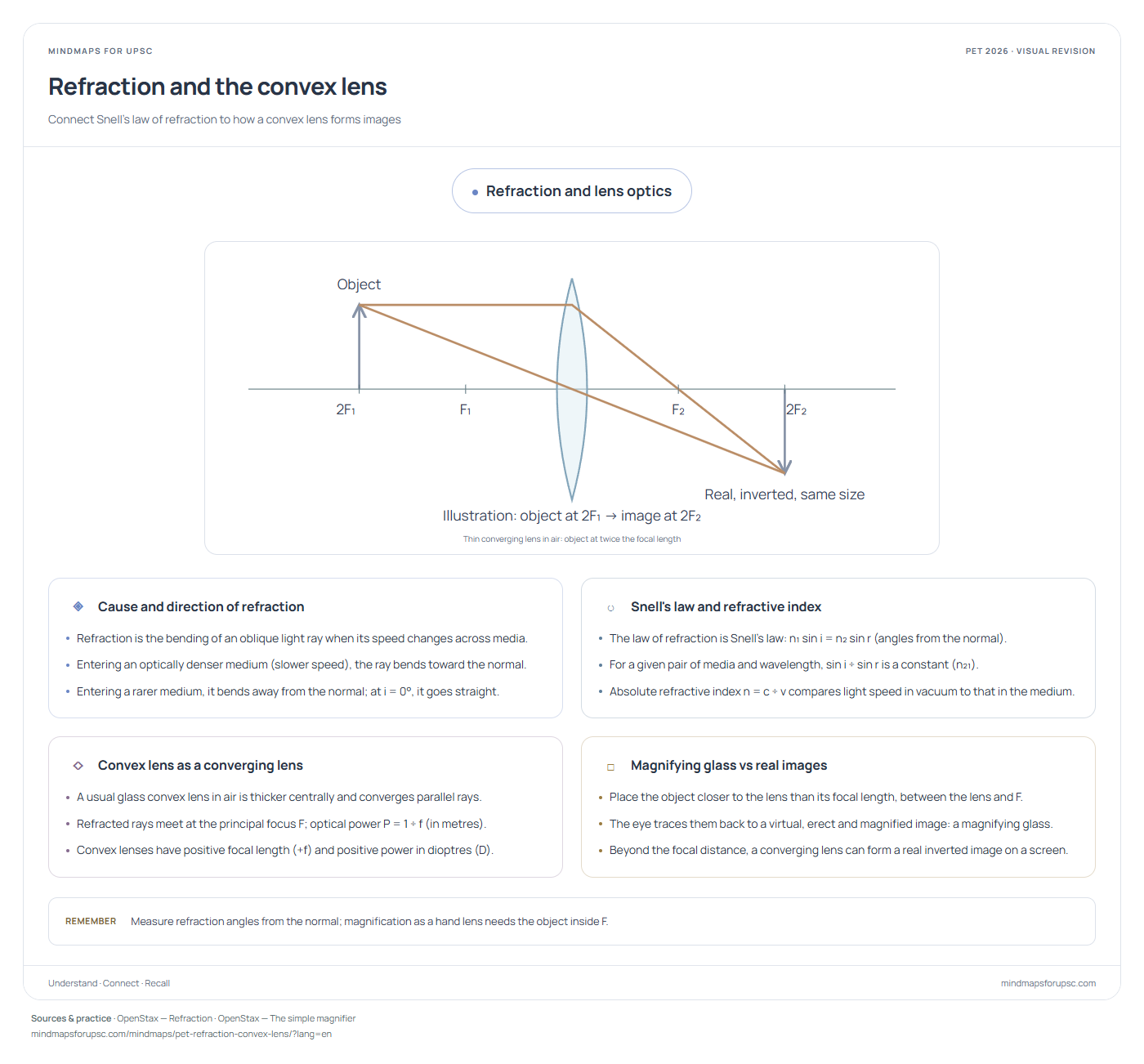
Thin converging lens in air: object at twice the focal lengthSwipe sideways to explore the diagram.
◈
Cause and direction of refraction
- Refraction is the bending of an oblique light ray when its speed changes across media.
- Entering an optically denser medium (slower speed), the ray bends toward the normal.
- Entering a rarer medium, it bends away from the normal; at i = 0°, it goes straight.
○
Snell's law and refractive index
- The law of refraction is Snell's law: n₁ sin i = n₂ sin r (angles from the normal).
- For a given pair of media and wavelength, sin i ÷ sin r is a constant (n₂₁).
- Absolute refractive index n = c ÷ v compares light speed in vacuum to that in the medium.
◇
Convex lens as a converging lens
- A usual glass convex lens in air is thicker centrally and converges parallel rays.
- Refracted rays meet at the principal focus F; optical power P = 1 ÷ f (in metres).
- Convex lenses have positive focal length (+f) and positive power in dioptres (D).
□
Magnifying glass vs real images
- Place the object closer to the lens than its focal length, between the lens and F.
- The eye traces them back to a virtual, erect and magnified image: a magnifying glass.
- Beyond the focal distance, a converging lens can form a real inverted image on a screen.
अपवर्तन और लेंस प्रकाशिकी
वायु में पतला अभिसारी लेंस: वस्तु 2F परआरेख देखने के लिए दाएँ-बाएँ खिसकाएँ।
◈
अपवर्तन का कारण और मुड़ने की दिशा
- जब प्रकाश की किरण एक माध्यम से दूसरे माध्यम में तिरछी प्रवेश करती है, तो चाल बदलने से वह अपने पथ से मुड़ जाती है।
- विरल से प्रकाशतः सघन माध्यम (जहाँ चाल कम हो) में जाने पर किरण अभिलंब (Normal) की ओर झुकती है।
- सघन से विरल माध्यम में जाने पर किरण अभिलंब से दूर हटती है; अभिलंबवत् आपतन (i = 0°) पर बिना मुड़े सीधी निकलती है।
○
स्नेल का नियम और अपवर्तनांक
- अपवर्तन के द्वितीय नियम को 'स्नेल का नियम' कहते हैं: n₁ sin i = n₂ sin r (कोण अभिलंब से मापे जाते हैं)।
- किन्हीं दो माध्यमों और निश्चित रंग के प्रकाश के लिए आपतन कोण की ज्या और अपवर्तन कोण की ज्या का अनुपात स्थिर (sin i / sin r = n₂₁) रहता है।
- निरपेक्ष अपवर्तनांक n = c ÷ v निर्वात में प्रकाश की चाल (c) और माध्यम में प्रकाश की चाल (v) का अनुपात है।
◇
अभिसारी लेंस के रूप में उत्तल लेंस
- वायु में सामान्य काँच का उत्तल लेंस बीच में मोटा होता है और समानांतर किरणों को अभिसरित करता है।
- अपवर्तन के पश्चात् समानांतर किरणें मुख्य फोकस (F) पर मिलती हैं; लेंस की क्षमता P = 1 ÷ f (मीटर में) होती है।
- उत्तल लेंस की फोकस दूरी (+f) और क्षमता (डायोप्टर D में) धनात्मक होती है।
□
आवर्धक काँच बनाम वास्तविक प्रतिबिंब
- वस्तु को लेंस और F के बीच, फोकस-दूरी से कम दूरी पर रखें।
- इन्हें पीछे बढ़ाने पर वस्तु की ओर ही आभासी, सीधा और बड़ा प्रतिबिंब बनता है—इसी रूप में उत्तल लेंस 'आवर्धक काँच' है।
- फोकस-दूरी से बाहर रखी वस्तु का अभिसारी लेंस पर्दे पर वास्तविक, उलटा प्रतिबिंब बना सकता है।
Practise this concept · संबंधित प्रश्न
One visual, several questions. These links open the original paper at the matching question.
Sources & study notes · स्रोत
Independent revision material, linked to the paper’s concepts. The question papers and answer-key status are available on OpenPYQ.