PET 2026 · CSAT
Choose the right percentage base प्रतिशत गणना में सही आधार का चयन A four-step workflow to decode wording, fix the denominator and avoid base-shift traps प्रश्न की भाषा समझने, हर (आधार) तय करने और आधार-परिवर्तन की त्रुटियों से बचने की चार-चरणीय विधि
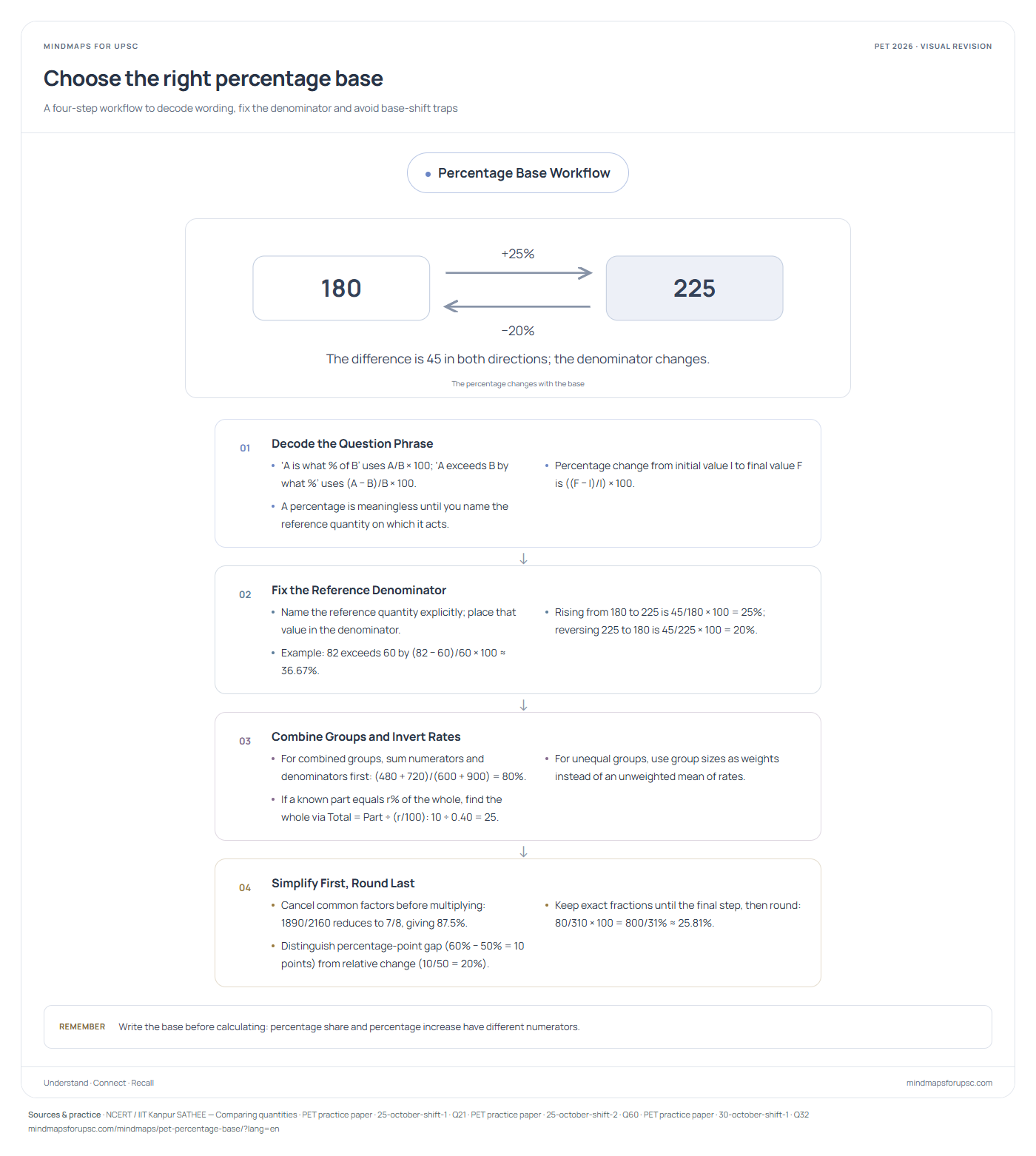
The percentage changes with the base 180 225 +25% −20% The difference is 45 in both directions; the denominator changes. The percentage changes with the baseSwipe sideways to explore the diagram.
01
Decode the Question Phrase
‘A is what % of B’ uses A/B × 100; ‘A exceeds B by what %’ uses (A − B)/B × 100. Percentage change from initial value I to final value F is ((F − I)/I) × 100. A percentage is meaningless until you name the reference quantity on which it acts.
02
Fix the Reference Denominator
Name the reference quantity explicitly; place that value in the denominator. Rising from 180 to 225 is 45/180 × 100 = 25%; reversing 225 to 180 is 45/225 × 100 = 20%. Example: 82 exceeds 60 by (82 − 60)/60 × 100 ≈ 36.67%.
03
Combine Groups and Invert Rates
For combined groups, sum numerators and denominators first: (480 + 720)/(600 + 900) = 80%. For unequal groups, use group sizes as weights instead of an unweighted mean of rates. If a known part equals r% of the whole, find the whole via Total = Part ÷ (r/100): 10 ÷ 0.40 = 25.
04
Simplify First, Round Last
Cancel common factors before multiplying: 1890/2160 reduces to 7/8, giving 87.5%. Keep exact fractions until the final step, then round: 80/310 × 100 = 800/31% ≈ 25.81%. Distinguish percentage-point gap (60% − 50% = 10 points) from relative change (10/50 = 20%). Remember Write the base before calculating: percentage share and percentage increase have different numerators.
आधार बदलने पर प्रतिशत भी बदलता है 180 225 +25% −20% दोनों दिशाओं में अंतर 45 है; हर बदलता है। आधार बदलने पर प्रतिशत भी बदलता हैआरेख देखने के लिए दाएँ-बाएँ खिसकाएँ।
01
प्रश्न के वाक्यांश को समझें
‘A, B का कितना % है’ के लिए A/B × 100; तथा ‘A, B से कितना % अधिक है’ के लिए (A − B)/B × 100 लगाएँ। प्रारंभिक मान I से अंतिम मान F तक प्रतिशत परिवर्तन ((F − I)/I) × 100 होता है। कोई भी प्रतिशत तब तक अधूरा है जब तक उसका संदर्भ-आधार स्पष्ट न किया जाए।
02
हर (Denominator) में सही आधार रखें
संदर्भ-आधार को स्पष्ट नाम दें और उसी मान को हर में रखें। 180 से 225 होना 45/180 × 100 = 25% वृद्धि है, पर 225 से 180 लौटना 45/225 × 100 = 20% कमी है। उदाहरण: 82, 60 से (82 − 60)/60 × 100 ≈ 36.67% अधिक है।
03
समूहों का संयोजन और कुल मान निकालना
संयुक्त समूहों के लिए पहले अंश और हर जोड़ें, फिर भाग दें: (480 + 720)/(600 + 900) = 80%। असमान समूहों में दरों का साधारण माध्य लेने के बजाय समूहों के आकार को भार बनाएँ। यदि कुल का r% ज्ञात हो, तो कुल मान = भाग ÷ (r/100); जैसे 40% जीत पर 10 मैच ⇒ कुल = 10 ÷ 0.40 = 25।
04
पहले सरलीकरण, अंत में पूर्णांकन
गुणा करने से पहले उभयनिष्ठ गुणनखंड काटें: 1890/2160 सरल होकर 7/8 अर्थात् 87.5% देता है। अंतिम चरण तक भिन्न को सटीक रखें, फिर पूर्णांकित करें: 80/310 × 100 = 800/31% ≈ 25.81%। प्रतिशत-अंक अंतर (60% − 50% = 10 अंक) और सापेक्ष प्रतिशत वृद्धि (10/50 = 20%) में भेद रखें।
Practise this concept · संबंधित प्रश्न One visual, several questions. These links open the original paper at the matching question.
Sources & study notes · स्रोत Independent revision material, linked to the paper’s concepts. The question papers and answer-key status are available on OpenPYQ.