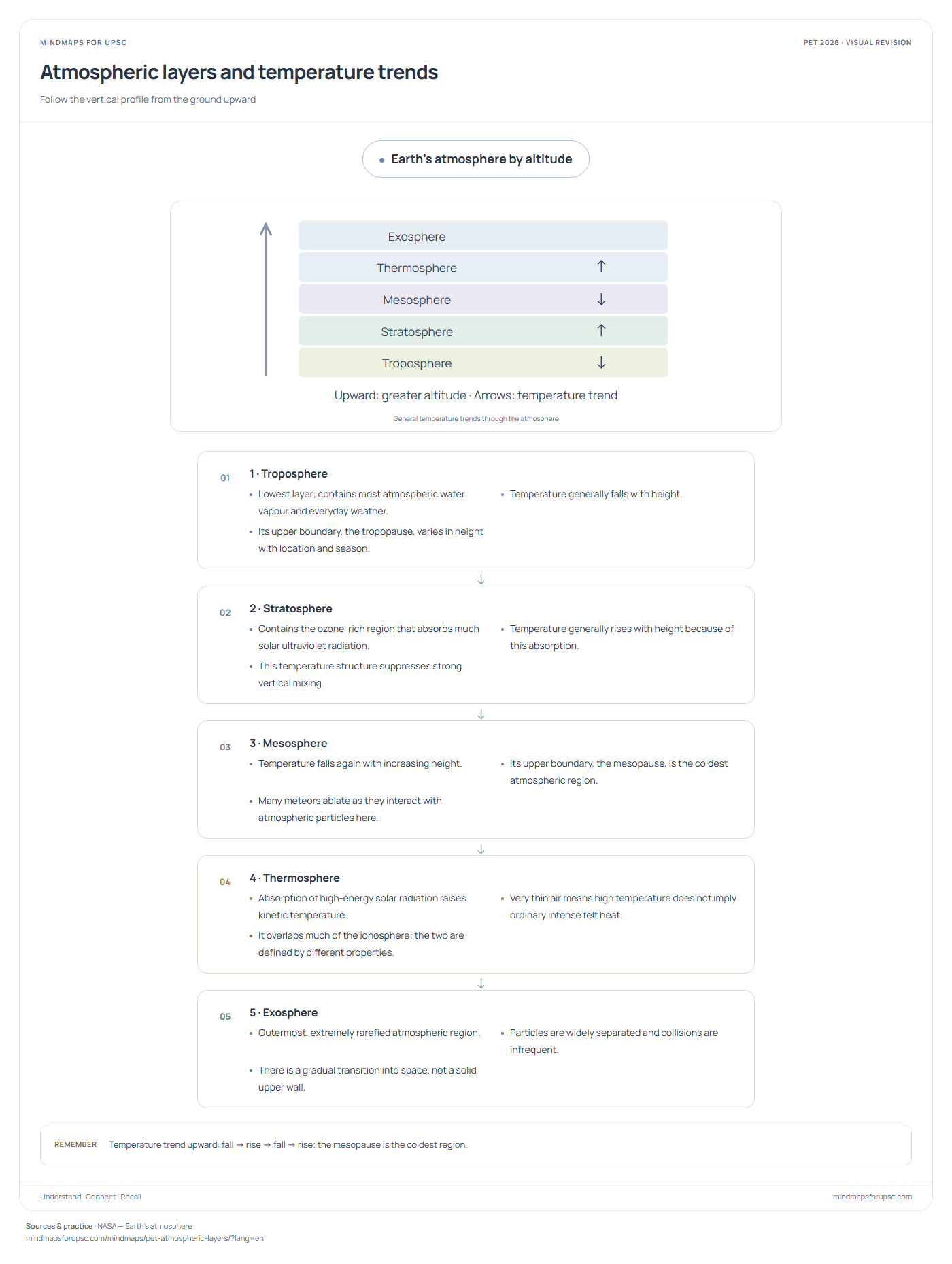
Earth's atmosphere by altitude
General temperature trends through the atmosphereSwipe sideways to explore the diagram.
-
01
1 · Troposphere
- Lowest layer; contains most atmospheric water vapour and everyday weather.
- Temperature generally falls with height.
- Its upper boundary, the tropopause, varies in height with location and season.
-
02
2 · Stratosphere
- Contains the ozone-rich region that absorbs much solar ultraviolet radiation.
- Temperature generally rises with height because of this absorption.
- This temperature structure suppresses strong vertical mixing.
-
03
3 · Mesosphere
- Temperature falls again with increasing height.
- Its upper boundary, the mesopause, is the coldest atmospheric region.
- Many meteors ablate as they interact with atmospheric particles here.
-
04
4 · Thermosphere
- Absorption of high-energy solar radiation raises kinetic temperature.
- Very thin air means high temperature does not imply ordinary intense felt heat.
- It overlaps much of the ionosphere; the two are defined by different properties.
-
05
5 · Exosphere
- Outermost, extremely rarefied atmospheric region.
- Particles are widely separated and collisions are infrequent.
- There is a gradual transition into space, not a solid upper wall.
ऊँचाई के अनुसार पृथ्वी का वायुमंडल
वायुमंडल में तापमान की सामान्य प्रवृत्तियाँआरेख देखने के लिए दाएँ-बाएँ खिसकाएँ।
-
01
1 · क्षोभमंडल
- सबसे निचली परत; अधिकांश वायुमंडलीय जलवाष्प और दैनिक मौसम की घटनाएँ यहीं होती हैं।
- ऊँचाई के साथ तापमान सामान्यतः घटता है।
- इसकी ऊपरी सीमा क्षोभसीमा की ऊँचाई स्थान और ऋतु के अनुसार बदलती है।
-
02
2 · समतापमंडल
- इसका ओज़ोन-समृद्ध क्षेत्र सूर्य के बहुत-से पराबैंगनी विकिरण को अवशोषित करता है।
- इस अवशोषण के कारण ऊँचाई के साथ तापमान सामान्यतः बढ़ता है।
- तापमान का यह वितरण तीव्र ऊर्ध्वाधर मिश्रण को सीमित करता है।
-
03
3 · मध्यमंडल
- यहाँ ऊँचाई बढ़ने पर तापमान फिर घटता है।
- इसकी ऊपरी सीमा, मध्यसीमा, वायुमंडल का सबसे ठंडा क्षेत्र है।
- यहाँ वायुमंडलीय कणों से अंतःक्रिया के कारण अनेक उल्काएँ क्षय हो जाती हैं।
-
04
4 · तापमंडल
- उच्च-ऊर्जा सौर विकिरण के अवशोषण से कणों का गतिज ताप बढ़ता है।
- अत्यंत विरल वायु में ऊँचा तापमान सामान्य अनुभव जैसी तीव्र गर्मी का अर्थ नहीं रखता।
- इसका बड़ा भाग आयनमंडल से मिलता है; दोनों का वर्गीकरण अलग गुणों पर आधारित है।
-
05
5 · बहिर्मंडल
- वायुमंडल का सबसे बाहरी, अत्यंत विरल क्षेत्र।
- कण बहुत दूर-दूर होते हैं और उनके बीच टक्करें कम होती हैं।
- यह धीरे-धीरे अंतरिक्ष में मिलता है; इसकी ऊपरी सीमा कोई ठोस दीवार नहीं है।
Practise this concept · संबंधित प्रश्न
One visual, several questions. These links open the original paper at the matching question.
Sources & study notes · स्रोत
Independent revision material, linked to the paper’s concepts. The question papers and answer-key status are available on OpenPYQ.