PET 2026 · Science
Body regulation: brain signals and blood pressure शारीरिक नियंत्रण: मस्तिष्क के भाग और रक्तदाब Match each brain region to its control role and read systolic/diastolic pressure हाइपोथैलेमस, प्रमस्तिष्क, अनुमस्तिष्क व मेडुला के कार्य तथा प्रकुंचन/अनुशिथिलन रक्तदाब
◈
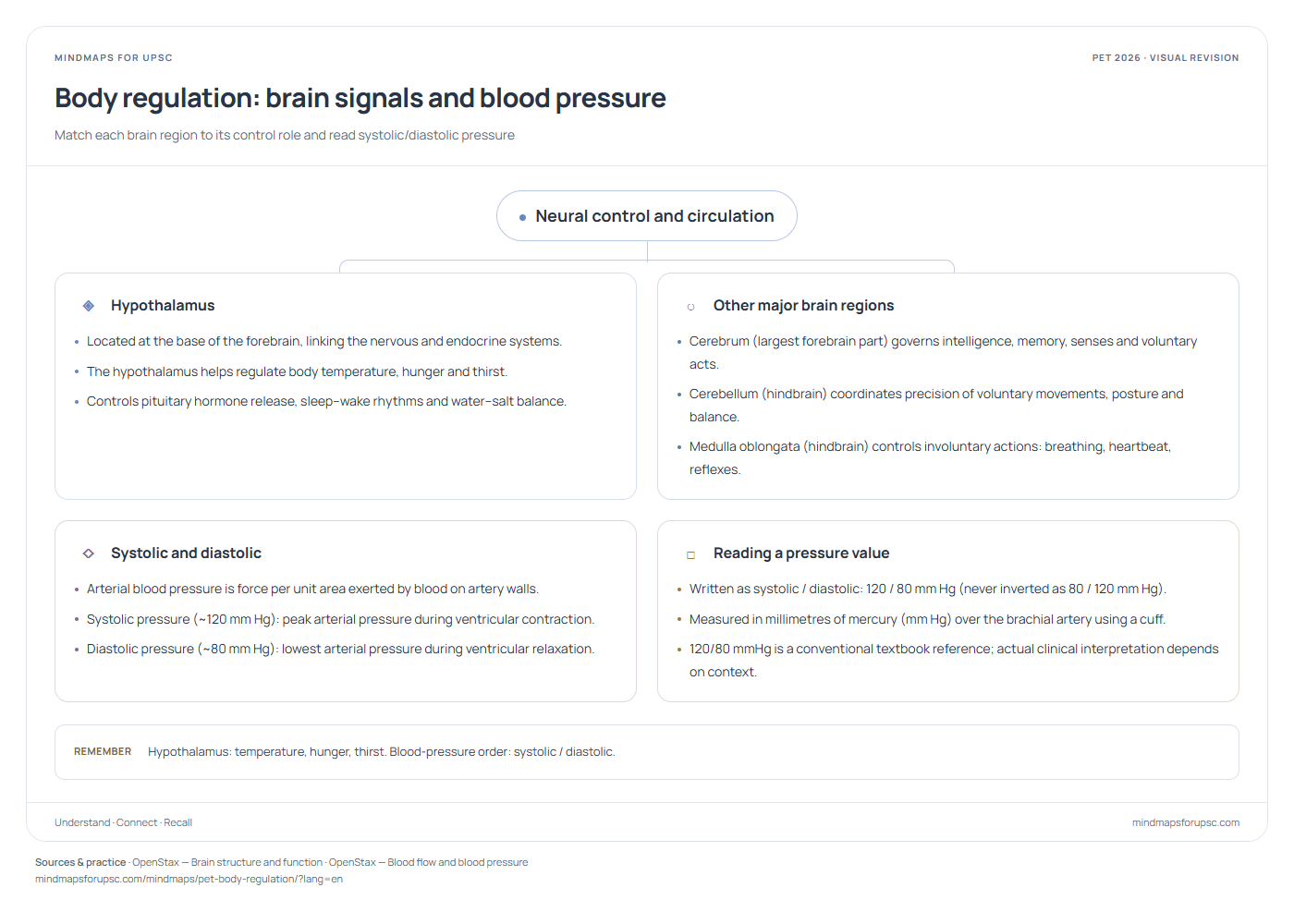
Hypothalamus
Located at the base of the forebrain, linking the nervous and endocrine systems. The hypothalamus helps regulate body temperature, hunger and thirst. Controls pituitary hormone release, sleep–wake rhythms and water–salt balance.
○
Other major brain regions
Cerebrum (largest forebrain part) governs intelligence, memory, senses and voluntary acts. Cerebellum (hindbrain) coordinates precision of voluntary movements, posture and balance. Medulla oblongata (hindbrain) controls involuntary actions: breathing, heartbeat, reflexes.
◇
Systolic and diastolic
Arterial blood pressure is force per unit area exerted by blood on artery walls. Systolic pressure (~120 mm Hg): peak arterial pressure during ventricular contraction. Diastolic pressure (~80 mm Hg): lowest arterial pressure during ventricular relaxation.
□
Reading a pressure value
Written as systolic / diastolic: 120 / 80 mm Hg (never inverted as 80 / 120 mm Hg). Measured in millimetres of mercury (mm Hg) over the brachial artery using a cuff. 120/80 mmHg is a conventional textbook reference; actual clinical interpretation depends on context. Remember Hypothalamus: temperature, hunger, thirst. Blood-pressure order: systolic / diastolic.
◈
हाइपोथैलेमस
यह अग्रमस्तिष्क के आधार पर स्थित होता है और तंत्रिका तंत्र को अंतःस्रावी तंत्र (पीयूष ग्रंथि) से जोड़ता है। हाइपोथैलेमस शरीर के तापमान, भूख और प्यास के नियंत्रण में सहायता करता है। यह पीयूष ग्रंथि के हार्मोनों के स्राव, निद्रा-जागरण चक्र और जल-लवण संतुलन (समस्थापन) को भी नियंत्रित करता है।
○
मस्तिष्क के अन्य प्रमुख भाग
प्रमस्तिष्क (सेरीब्रम—सबसे बड़ा भाग) बुद्धि, स्मृति, चिंतन, संवेदनाओं और ऐच्छिक क्रियाओं का केंद्र है। अनुमस्तिष्क (सेरेबेलम—पश्चमस्तिष्क) शरीर का संतुलन, भंगिमा (पॉश्चर) और ऐच्छिक पेशीय समन्वय बनाए रखता है। मेडुला ऑब्लॉन्गाटा (पश्चमस्तिष्क) श्वसन, हृदय की धड़कन, रक्तदाब और उल्टी/खाँसी जैसी अनैच्छिक क्रियाओं को नियंत्रित करता है।
◇
प्रकुंचन और अनुशिथिलन
धमनीय रक्तदाब, रक्त द्वारा धमनी की दीवार पर प्रति इकाई क्षेत्रफल लगाया गया बल है। प्रकुंचन दाब (Systolic, ~120 mm Hg): हृदय के निलयों के संकुचन के समय धमनियों के भीतर का अधिकतम दाब। अनुशिथिलन दाब (Diastolic, ~80 mm Hg): निलयों के शिथिलन (विश्राम) के दौरान धमनियों में रहने वाला न्यूनतम दाब।
□
रक्तदाब के मान का पठन
इसे सदैव 'प्रकुंचन / अनुशिथिलन' के क्रम में 120 mm Hg / 80 mm Hg लिखा जाता है (80 / 120 के उल्टे क्रम में नहीं)। रक्तदाब को 'स्फिग्मोमैनोमीटर' यंत्र द्वारा पारे के मिलीमीटर (mm Hg) में बाँह की धमनी पर मापा जाता है। 120/80 mmHg पाठ्यपुस्तकीय संदर्भ है; वास्तविक माप की चिकित्सकीय व्याख्या परिस्थितियों पर निर्भर करती है। याद रखें हाइपोथैलेमस: तापमान, भूख, प्यास। रक्तदाब लिखने का क्रम: प्रकुंचन / अनुशिथिलन।
Practise this concept · संबंधित प्रश्न One visual, several questions. These links open the original paper at the matching question.
Sources & study notes · स्रोत Independent revision material, linked to the paper’s concepts. The question papers and answer-key status are available on OpenPYQ.