PET 2026 · CSAT
Calendars through remainders modulo sevenसात के शेषफल से कैलेंडर गणना
Month lengths, leap-year tests, odd-day shifts and calendar repetitionमाह की लंबाई, लीप-वर्ष परीक्षण, विषम-दिन विस्थापन और कैलेंडर की पुनरावृत्ति
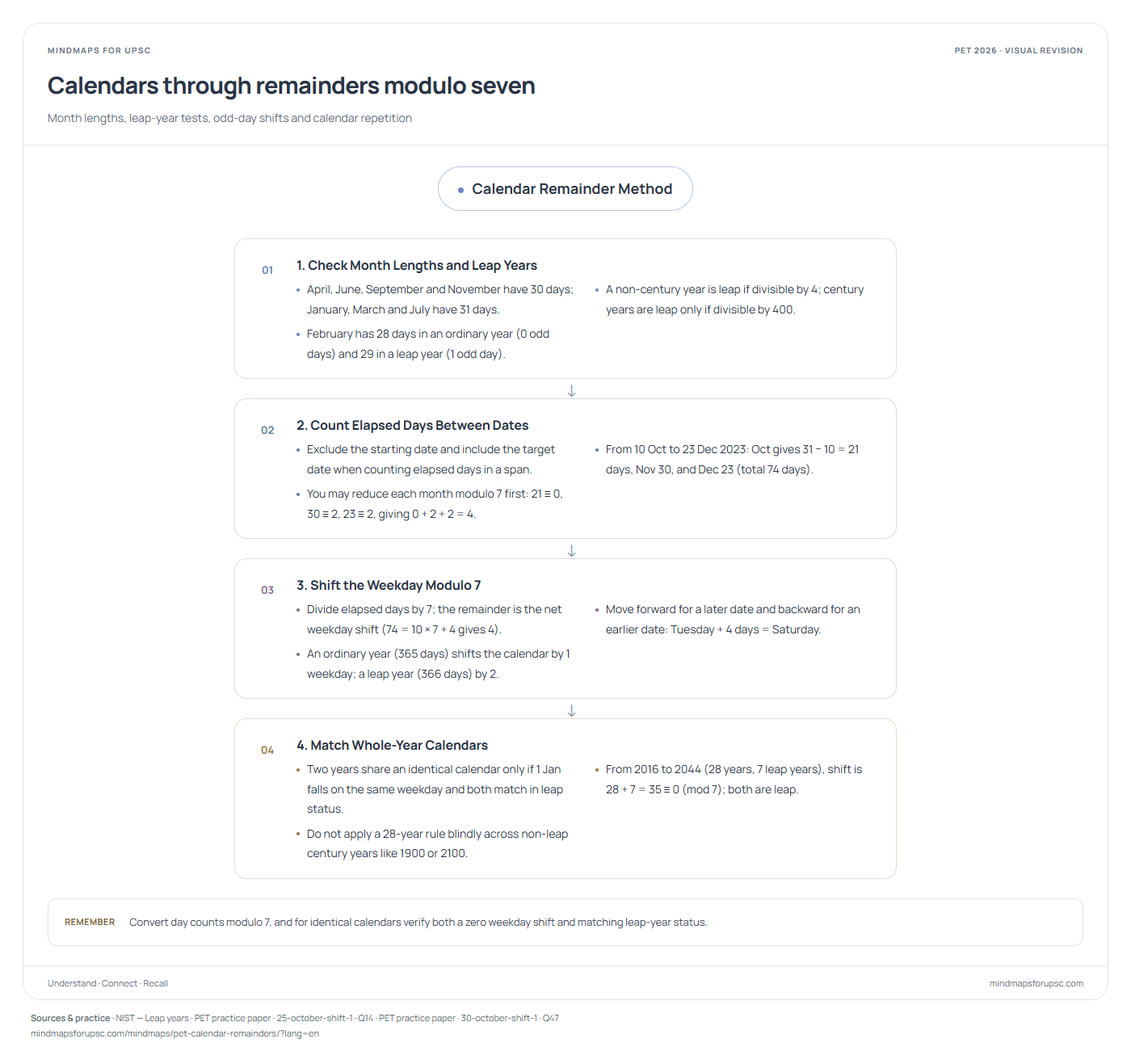
Calendar Remainder Method
-
01
1. Check Month Lengths and Leap Years
- April, June, September and November have 30 days; January, March and July have 31 days.
- A non-century year is leap if divisible by 4; century years are leap only if divisible by 400.
- February has 28 days in an ordinary year (0 odd days) and 29 in a leap year (1 odd day).
-
02
2. Count Elapsed Days Between Dates
- Exclude the starting date and include the target date when counting elapsed days in a span.
- From 10 Oct to 23 Dec 2023: Oct gives 31 − 10 = 21 days, Nov 30, and Dec 23 (total 74 days).
- You may reduce each month modulo 7 first: 21 ≡ 0, 30 ≡ 2, 23 ≡ 2, giving 0 + 2 + 2 = 4.
-
03
3. Shift the Weekday Modulo 7
- Divide elapsed days by 7; the remainder is the net weekday shift (74 = 10 × 7 + 4 gives 4).
- Move forward for a later date and backward for an earlier date: Tuesday + 4 days = Saturday.
- An ordinary year (365 days) shifts the calendar by 1 weekday; a leap year (366 days) by 2.
-
04
4. Match Whole-Year Calendars
- Two years share an identical calendar only if 1 Jan falls on the same weekday and both match in leap status.
- From 2016 to 2044 (28 years, 7 leap years), shift is 28 + 7 = 35 ≡ 0 (mod 7); both are leap.
- Do not apply a 28-year rule blindly across non-leap century years like 1900 or 2100.
कैलेंडर शेषफल विधि
-
01
1. माह के दिन और लीप-वर्ष जाँचें
- अप्रैल, जून, सितंबर और नवंबर में 30 दिन होते हैं; जनवरी, मार्च और जुलाई में 31 दिन होते हैं।
- गैर-शताब्दी वर्ष 4 से विभाज्य होने पर लीप होता है; शताब्दी वर्ष केवल 400 से विभाज्य होने पर लीप होता है।
- फरवरी में साधारण वर्ष में 28 दिन (0 विषम दिन) और लीप वर्ष में 29 दिन (1 विषम दिन) होते हैं।
-
02
2. दो तिथियों के बीच बीते दिन गिनें
- अवधि के बीते दिन गिनते समय प्रारंभिक तिथि को छोड़ें और अंतिम लक्ष्य तिथि को शामिल करें।
- 10 अक्टू. से 23 दिसं. 2023 तक: अक्टू. के 31 − 10 = 21, नवं. के 30 और दिसं. के 23 दिन (कुल 74 दिन)।
- प्रत्येक माह को पहले 7 से भाग दे सकते हैं: 21 ≡ 0, 30 ≡ 2, 23 ≡ 2; कुल विषम दिन = 0 + 2 + 2 = 4।
-
03
3. शेषफल से वार आगे-पीछे करें
- कुल दिनों को 7 से भाग दें; प्राप्त शेषफल ही वार का शुद्ध विस्थापन है (74 = 10 × 7 + 4 से शेष 4)।
- आगे की तिथि के लिए आगे और पिछली तिथि के लिए पीछे गिनें: मंगलवार + 4 दिन = शनिवार।
- साधारण वर्ष (365 दिन) कैलेंडर को 1 वार आगे बढ़ाता है; लीप वर्ष (366 दिन) 2 वार आगे बढ़ाता है।
-
04
4. पूरे वर्ष के कैलेंडर का मिलान
- दो वर्षों का कैलेंडर तभी समान होता है जब 1 जनवरी का वार समान हो और दोनों का लीप/साधारण प्रकार भी समान हो।
- 2016 से 2044 तक (28 वर्ष, 7 लीप वर्ष) विस्थापन 28 + 7 = 35 ≡ 0 (mod 7) है और दोनों लीप वर्ष हैं।
- 1900 या 2100 जैसे गैर-लीप शताब्दी वर्षों को पार करते समय 28-वर्षीय नियम का अंधानुकरण न करें।
Practise this concept · संबंधित प्रश्न
One visual, several questions. These links open the original paper at the matching question.
Sources & study notes · स्रोत
Independent revision material, linked to the paper’s concepts. The question papers and answer-key status are available on OpenPYQ.