MINDMAPS FOR UPSCPET 2026 · VISUAL REVISION
Decode a rule and verify it
Distinguish direct substitution, alphabet-position sums and multiplicative number patterns
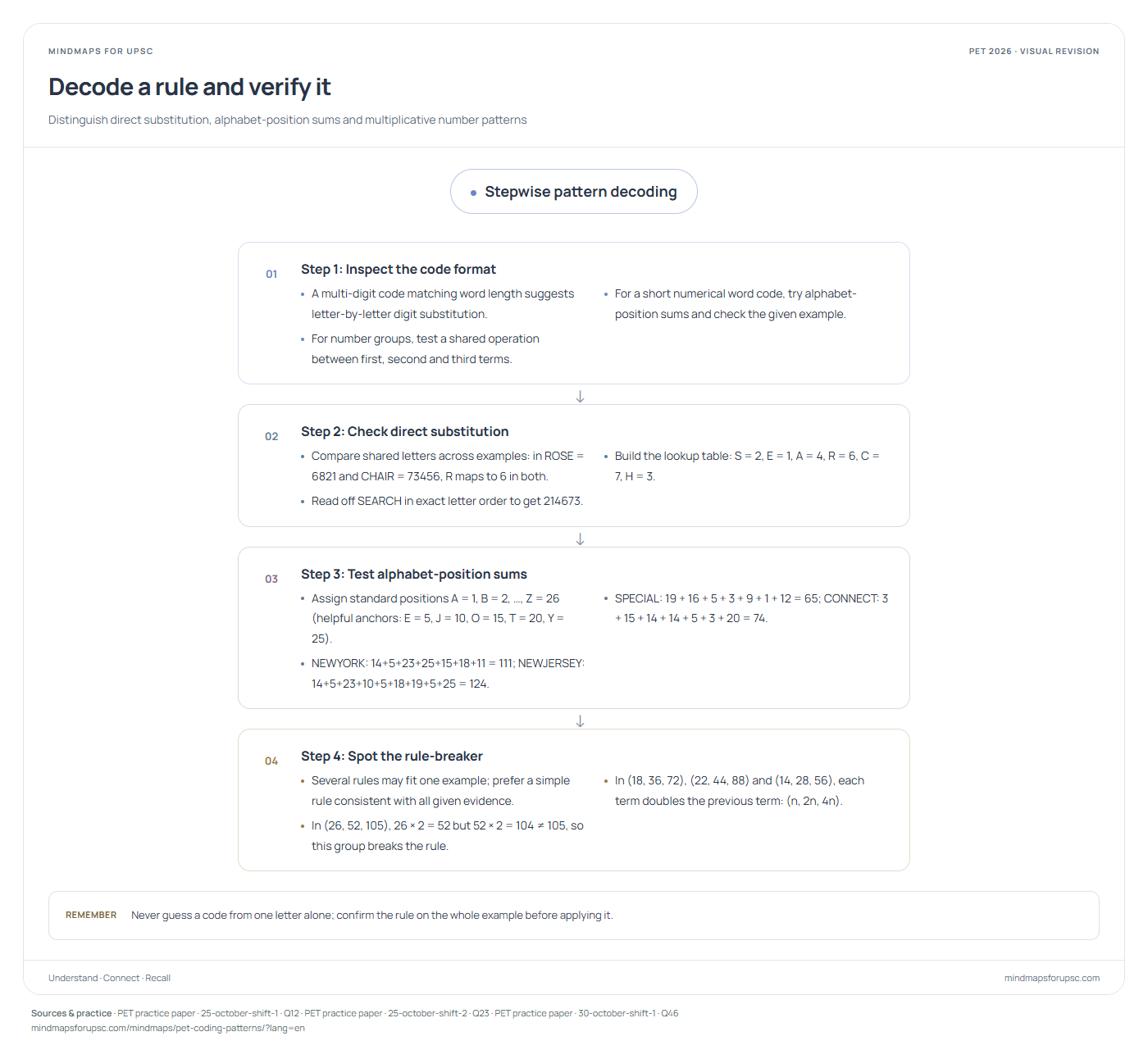
Stepwise pattern decoding
-
Step 1: Inspect the code format
- A multi-digit code matching word length suggests letter-by-letter digit substitution.
- For a short numerical word code, try alphabet-position sums and check the given example.
- For number groups, test a shared operation between first, second and third terms.
-
Step 2: Check direct substitution
- Compare shared letters across examples: in ROSE = 6821 and CHAIR = 73456, R maps to 6 in both.
- Build the lookup table: S = 2, E = 1, A = 4, R = 6, C = 7, H = 3.
- Read off SEARCH in exact letter order to get 214673.
-
Step 3: Test alphabet-position sums
- Assign standard positions A = 1, B = 2, …, Z = 26 (helpful anchors: E = 5, J = 10, O = 15, T = 20, Y = 25).
- SPECIAL: 19 + 16 + 5 + 3 + 9 + 1 + 12 = 65; CONNECT: 3 + 15 + 14 + 14 + 5 + 3 + 20 = 74.
- NEWYORK: 14+5+23+25+15+18+11 = 111; NEWJERSEY: 14+5+23+10+5+18+19+5+25 = 124.
-
Step 4: Spot the rule-breaker
- Several rules may fit one example; prefer a simple rule consistent with all given evidence.
- In (18, 36, 72), (22, 44, 88) and (14, 28, 56), each term doubles the previous term: (n, 2n, 4n).
- In (26, 52, 105), 26 × 2 = 52 but 52 × 2 = 104 ≠ 105, so this group breaks the rule.
Understand · Connect · Recallmindmapsforupsc.com