PET 2026 · History
Colonial reforms: what changed and what did notऔपनिवेशिक संवैधानिक सुधार: प्रमुख प्रावधान
Track the 1919 Act, the 1935 Act and the 1946 Cabinet Mission across provinces, federation and courts1919 के अधिनियम, 1935 के अधिनियम और 1946 के कैबिनेट मिशन के प्रांतीय, संघीय और न्यायिक प्रावधान
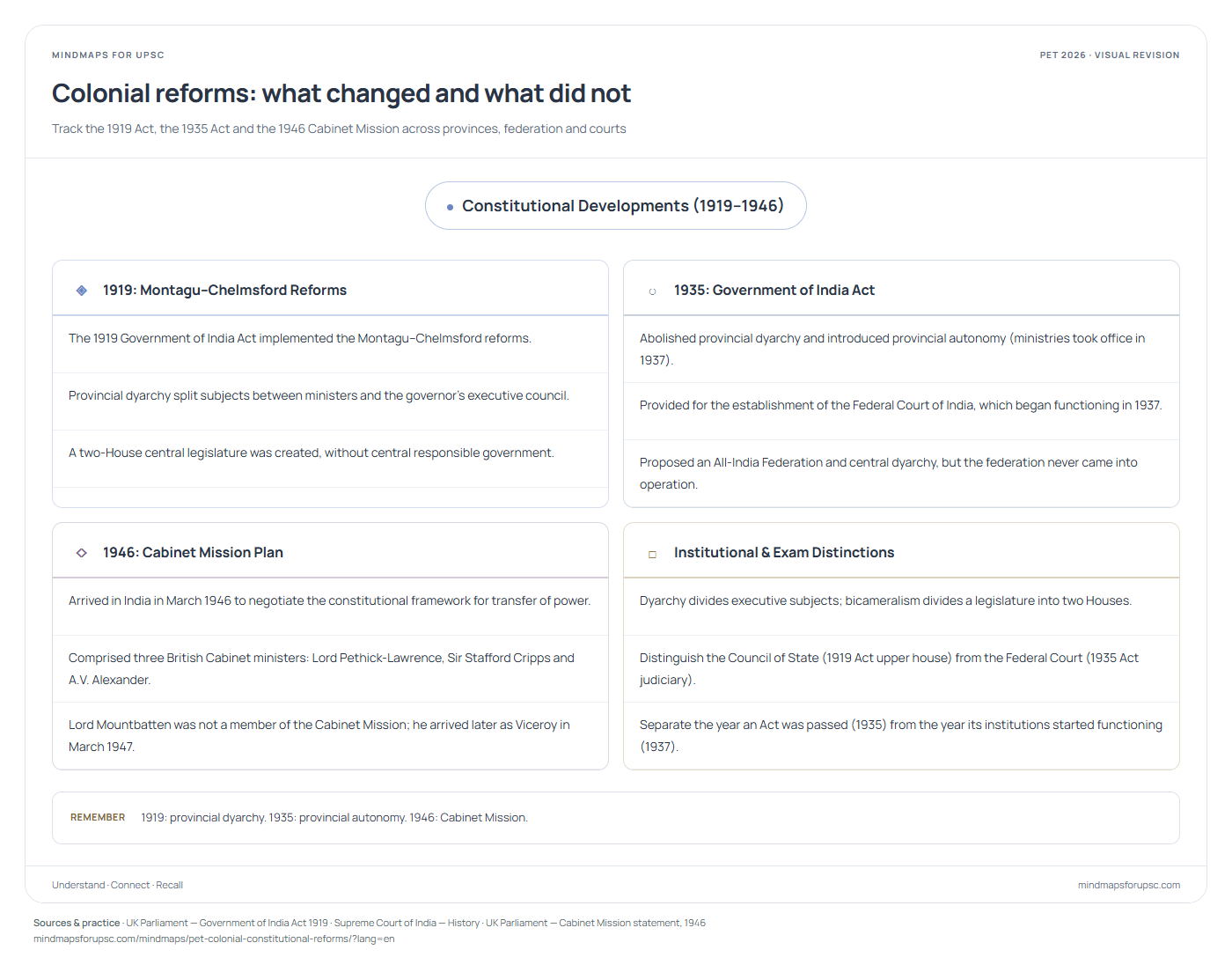
Constitutional Developments (1919–1946)
◈
1919: Montagu–Chelmsford Reforms
- The 1919 Government of India Act implemented the Montagu–Chelmsford reforms.
- Provincial dyarchy split subjects between ministers and the governor’s executive council.
- A two-House central legislature was created, without central responsible government.
○
1935: Government of India Act
- Abolished provincial dyarchy and introduced provincial autonomy (ministries took office in 1937).
- Provided for the establishment of the Federal Court of India, which began functioning in 1937.
- Proposed an All-India Federation and central dyarchy, but the federation never came into operation.
◇
1946: Cabinet Mission Plan
- Arrived in India in March 1946 to negotiate the constitutional framework for transfer of power.
- Comprised three British Cabinet ministers: Lord Pethick-Lawrence, Sir Stafford Cripps and A.V. Alexander.
- Lord Mountbatten was not a member of the Cabinet Mission; he arrived later as Viceroy in March 1947.
□
Institutional & Exam Distinctions
- Dyarchy divides executive subjects; bicameralism divides a legislature into two Houses.
- Distinguish the Council of State (1919 Act upper house) from the Federal Court (1935 Act judiciary).
- Separate the year an Act was passed (1935) from the year its institutions started functioning (1937).
संवैधानिक विकास-क्रम (1919–1946)
◈
1919: मोंटेग्यू-चेम्सफोर्ड सुधार
- भारत सरकार अधिनियम, 1919 ने मोंटेग्यू-चेम्सफोर्ड सुधार लागू किए।
- प्रांतीय द्वैध शासन में विषय मंत्रियों और राज्यपाल की कार्यकारी परिषद के बीच बाँटे गए।
- केंद्र में दो सदनों वाली विधायिका बनी, किंतु उत्तरदायी केंद्रीय शासन स्थापित नहीं हुआ।
○
1935: भारत सरकार अधिनियम
- प्रांतीय द्वैध शासन समाप्त कर प्रांतीय स्वायत्तता लागू की गई (1937 में प्रांतीय मंत्रिमंडलों ने कार्यभार सँभाला)।
- भारत के संघीय न्यायालय (Federal Court of India) की स्थापना का प्रावधान किया, जो 1937 में कार्यरत हुआ।
- अखिल भारतीय संघ और केंद्र में द्वैध शासन का प्रस्ताव रखा, किंतु रियासतों के शामिल न होने से संघ अस्तित्व में नहीं आया।
◇
1946: कैबिनेट मिशन योजना
- सत्ता हस्तांतरण के संवैधानिक ढाँचे पर वार्ता हेतु मार्च 1946 में कैबिनेट मिशन भारत आया।
- इसमें तीन ब्रिटिश कैबिनेट मंत्री शामिल थे: लॉर्ड पैथिक-लॉरेंस, सर स्टैफ़ोर्ड क्रिप्स और ए.वी. अलेक्जेंडर।
- लॉर्ड माउंटबेटन कैबिनेट मिशन के सदस्य नहीं थे; वे बाद में मार्च 1947 में वायसराय बनकर भारत आए।
□
संस्थागत एवं परीक्षा-उपयोगी विभेद
- द्वैध शासन में कार्यपालिका के विषय बँटते हैं; द्विसदनीयता में विधायिका के दो सदन होते हैं।
- राज्य परिषद (1919 अधिनियम का उच्च सदन) और संघीय न्यायालय (1935 अधिनियम की न्यायपालिका) में अंतर रखें।
- अधिनियम पारित होने के वर्ष (1935) और उसके तहत संस्थाओं के कार्य प्रारंभ करने के वर्ष (1937) में स्पष्ट अंतर रखें।
Practise this concept · संबंधित प्रश्न
One visual, several questions. These links open the original paper at the matching question.
Sources & study notes · स्रोत
Independent revision material, linked to the paper’s concepts. The question papers and answer-key status are available on OpenPYQ.