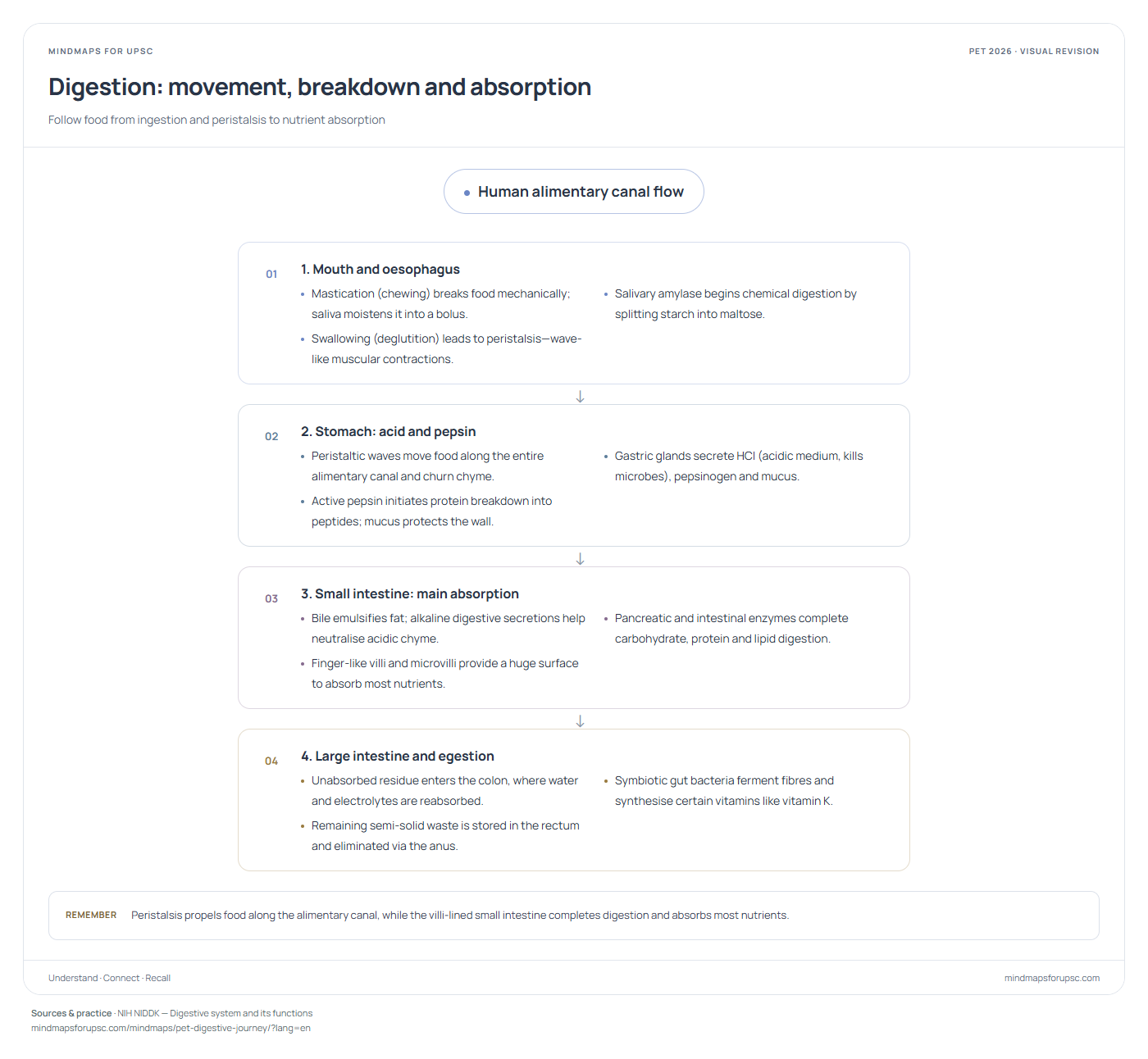
Human alimentary canal flow
-
01
1. Mouth and oesophagus
- Mastication (chewing) breaks food mechanically; saliva moistens it into a bolus.
- Salivary amylase begins chemical digestion by splitting starch into maltose.
- Swallowing (deglutition) leads to peristalsis—wave-like muscular contractions.
-
02
2. Stomach: acid and pepsin
- Peristaltic waves move food along the entire alimentary canal and churn chyme.
- Gastric glands secrete HCl (acidic medium, kills microbes), pepsinogen and mucus.
- Active pepsin initiates protein breakdown into peptides; mucus protects the wall.
-
03
3. Small intestine: main absorption
- Bile emulsifies fat; alkaline digestive secretions help neutralise acidic chyme.
- Pancreatic and intestinal enzymes complete carbohydrate, protein and lipid digestion.
- Finger-like villi and microvilli provide a huge surface to absorb most nutrients.
-
04
4. Large intestine and egestion
- Unabsorbed residue enters the colon, where water and electrolytes are reabsorbed.
- Symbiotic gut bacteria ferment fibres and synthesise certain vitamins like vitamin K.
- Remaining semi-solid waste is stored in the rectum and eliminated via the anus.
मानव आहारनाल का क्रमिक प्रवाह
-
01
1. मुखगुहा और ग्रासनली
- चर्वण (Mastication) द्वारा दाँत भोजन को चबाते हैं और लार उसे मिलाकर निगलने योग्य 'बोलस' बनाती है।
- लार में उपस्थित 'सैलाइवरी एमाइलेज' (टायलिन) मंड (स्टार्च) को माल्टोज़ शर्करा में बदलना शुरू करता है।
- निगलन (Deglutition) के बाद आहारनाल की पेशियों के तरंगीय संकुचन-शिथिलन अर्थात् 'क्रमाकुंचन' (Peristalsis) से भोजन आगे बढ़ता है।
-
02
2. आमाशय: अम्ल और पेप्सिन की क्रिया
- क्रमाकुंचन गति पूरे पाचन पथ में भोजन को आगे धकेलती है और आमाशय में उसे मथकर 'काइम' बनाती है।
- जठर ग्रंथियाँ हाइड्रोक्लोरिक अम्ल (HCl—अम्लीय माध्यम व रोगाणु नाश), पेप्सिनोजेन और श्लेष्मा स्रावित करती हैं।
- अम्लीय माध्यम में सक्रिय 'पेप्सिन' प्रोटीन को पेप्टाइड में तोड़ता है और श्लेष्मा आमाशय की भित्ति की रक्षा करती है।
-
03
3. छोटी आँत: पूर्ण पाचन और मुख्य अवशोषण
- पित्त वसा का इमल्सीकरण करता है; क्षारीय पाचक स्राव अम्लीय काइम को उदासीन करने में मदद करते हैं।
- अग्नाशयी और आँत के एंजाइम कार्बोहाइड्रेट (ग्लूकोज़), प्रोटीन (अमीनो अम्ल) और वसा (वसीय अम्ल) का पाचन पूर्ण करते हैं।
- छोटी आँत की भित्ति पर स्थित अंगुलीनुमा 'दीर्घरोम' (Villi) पचे हुए अधिकांश पोषक तत्त्वों का अवशोषण करते हैं।
-
04
4. बड़ी आँत: जल अवशोषण और बहिःक्षेपण
- अपचित और अनवशोषित पदार्थ बृहदान्त्र (बड़ी आँत) में जाता है, जहाँ मुख्यतः जल और खनिज लवणों का अवशोषण होता है।
- यहाँ रहने वाले सहजीवी जीवाणु रेशों का किण्वन करते हैं और विटामिन K तथा B-समूह के कुछ विटामिन बनाते हैं।
- शेष अर्ध-ठोस अपशिष्ट मलाशय में एकत्र होता है और गुदा द्वार से बाहर निष्कासित (बहिःक्षेपण) कर दिया जाता है।
Practise this concept · संबंधित प्रश्न
One visual, several questions. These links open the original paper at the matching question.
Sources & study notes · स्रोत
Independent revision material, linked to the paper’s concepts. The question papers and answer-key status are available on OpenPYQ.