PET 2026 · CSAT
Build a family tree before naming a relationसंबंध बताने से पहले वंश-वृक्ष बनाएँ
Generation levels, reference anchors and coded-relation decodingपीढ़ी स्तर, संदर्भ बिंदु और कूटबद्ध संबंधों की व्याख्या
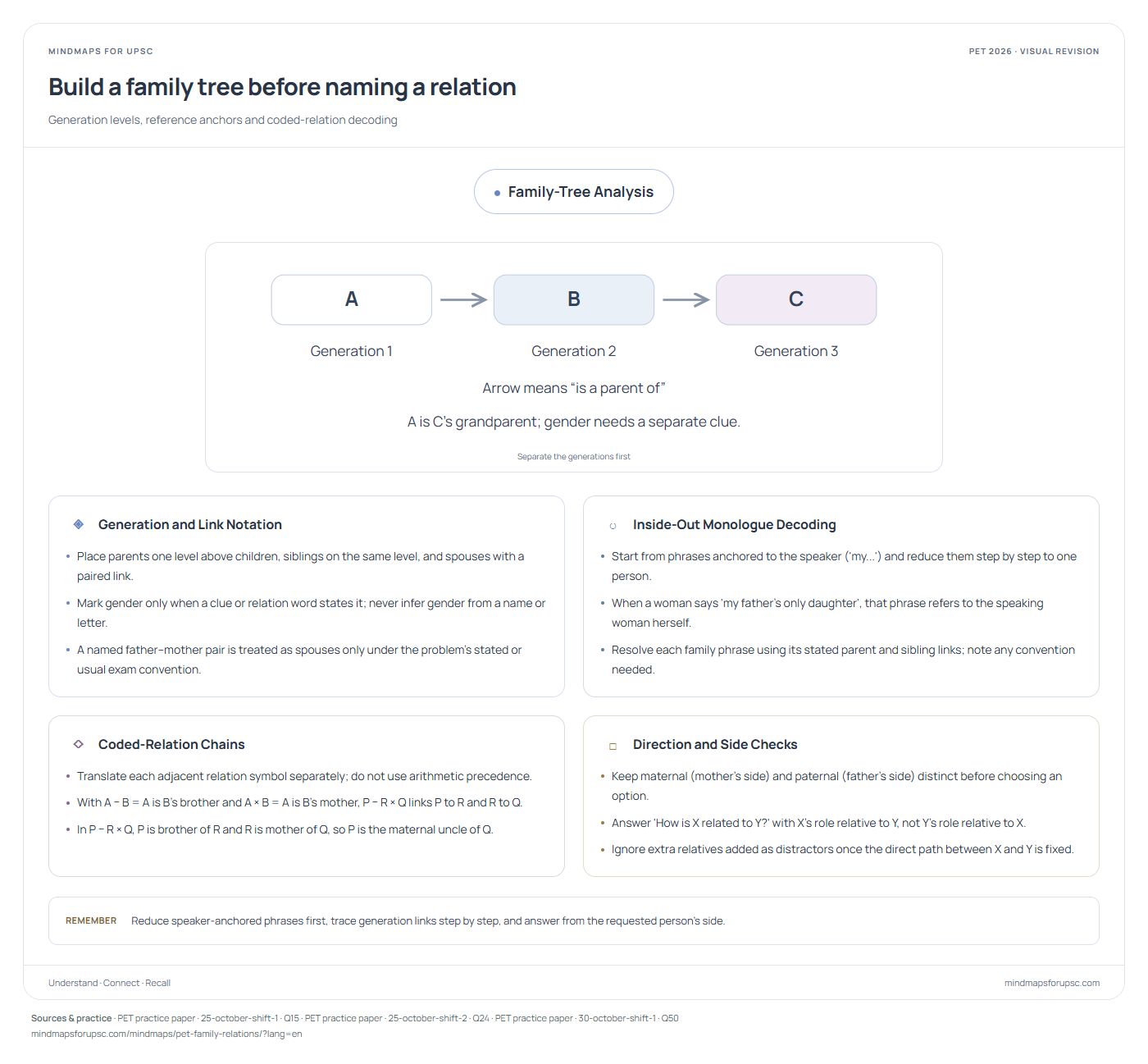
Family-Tree Analysis
Separate the generations firstSwipe sideways to explore the diagram.
◈
Generation and Link Notation
- Place parents one level above children, siblings on the same level, and spouses with a paired link.
- Mark gender only when a clue or relation word states it; never infer gender from a name or letter.
- A named father–mother pair is treated as spouses only under the problem’s stated or usual exam convention.
○
Inside-Out Monologue Decoding
- Start from phrases anchored to the speaker ('my...') and reduce them step by step to one person.
- When a woman says 'my father's only daughter', that phrase refers to the speaking woman herself.
- Resolve each family phrase using its stated parent and sibling links; note any convention needed.
◇
Coded-Relation Chains
- Translate each adjacent relation symbol separately; do not use arithmetic precedence.
- With A − B = A is B's brother and A × B = A is B's mother, P − R × Q links P to R and R to Q.
- In P − R × Q, P is brother of R and R is mother of Q, so P is the maternal uncle of Q.
□
Direction and Side Checks
- Keep maternal (mother's side) and paternal (father's side) distinct before choosing an option.
- Answer 'How is X related to Y?' with X's role relative to Y, not Y's role relative to X.
- Ignore extra relatives added as distractors once the direct path between X and Y is fixed.
वंश-वृक्ष विश्लेषण
पहले पीढ़ियाँ अलग करेंआरेख देखने के लिए दाएँ-बाएँ खिसकाएँ।
◈
पीढ़ी और संबंध संकेतन
- माता-पिता को संतान से एक स्तर ऊपर, भाई-बहन को समान स्तर पर और दंपति को युग्म चिह्न से दर्शाएँ।
- लिंग तभी अंकित करें जब संकेत या संबंध-शब्द में दिया हो; नाम या अक्षर से लिंग का अनुमान न लगाएँ।
- पिता-माता के युग्म को पति-पत्नी तभी मानें जब प्रश्न का कथन या सामान्य परीक्षा-परिपाटी यह मान्यता दे।
○
कथन की चरणबद्ध व्याख्या
- वक्ता से जुड़े वाक्यांशों ('मेरे...') से शुरुआत करें और उन्हें चरणबद्ध रूप से एक व्यक्ति तक सरल करें।
- जब कोई महिला 'मेरे पिता की इकलौती पुत्री' कहती है, तो वह वाक्यांश स्वयं उस वक्ता महिला को दर्शाता है।
- परिवार के हर वाक्यांश को बताए गए जनक और सहोदर संबंधों से खोलें; आवश्यक मान्यता स्पष्ट रखें।
◇
कूटबद्ध संबंध शृंखलाएँ
- हर पास-पास के संबंध-चिह्न का अलग अर्थ लिखें; अंकगणितीय प्राथमिकता न लगाएँ।
- यदि A − B = A, B का भाई और A × B = A, B की माँ है, तो P − R × Q में P का R से और R का Q से संबंध जुड़ता है।
- P − R × Q में P, R का भाई है और R, Q की माँ है; अतः P, Q का मामा है।
□
दिशा और पक्ष की जाँच
- विकल्प चुनने से पहले मातृपक्ष (माँ की ओर) और पितृपक्ष (पिता की ओर) का अंतर स्पष्ट रखें।
- 'X का Y से क्या संबंध है?' का उत्तर हमेशा Y के सापेक्ष X की भूमिका से दें, उल्टी दिशा से नहीं।
- X और Y के बीच सीधा संबंध तय हो जाने पर भ्रमित करने के लिए दिए गए अतिरिक्त रिश्तेदारों को छोड़ दें।
Practise this concept · संबंधित प्रश्न
One visual, several questions. These links open the original paper at the matching question.
Sources & study notes · स्रोत
Independent revision material, linked to the paper’s concepts. The question papers and answer-key status are available on OpenPYQ.