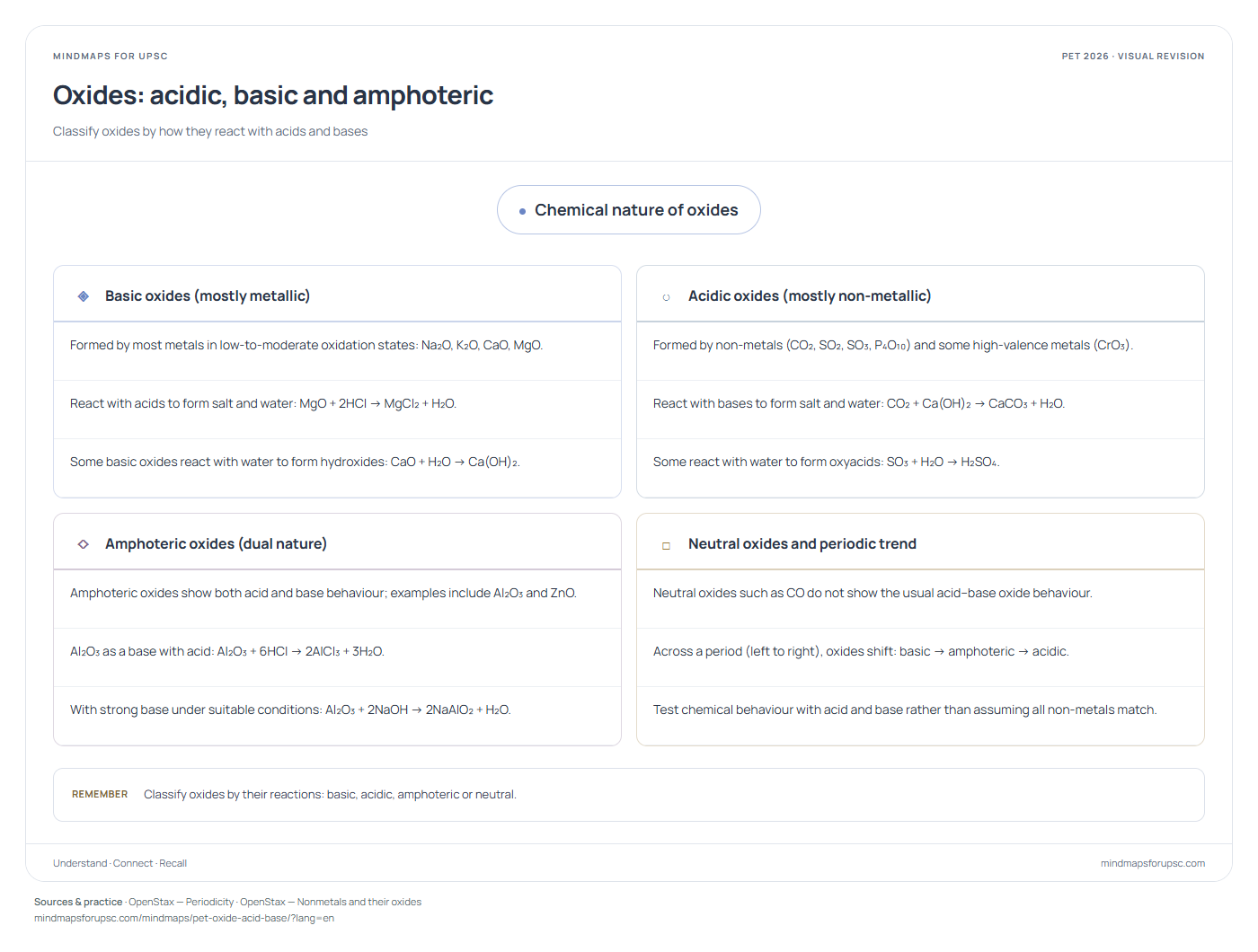
Chemical nature of oxides
◈
Basic oxides (mostly metallic)
- Formed by most metals in low-to-moderate oxidation states: Na₂O, K₂O, CaO, MgO.
- React with acids to form salt and water: MgO + 2HCl → MgCl₂ + H₂O.
- Some basic oxides react with water to form hydroxides: CaO + H₂O → Ca(OH)₂.
○
Acidic oxides (mostly non-metallic)
- Formed by non-metals (CO₂, SO₂, SO₃, P₄O₁₀) and some high-valence metals (CrO₃).
- React with bases to form salt and water: CO₂ + Ca(OH)₂ → CaCO₃ + H₂O.
- Some react with water to form oxyacids: SO₃ + H₂O → H₂SO₄.
◇
Amphoteric oxides (dual nature)
- Amphoteric oxides show both acid and base behaviour; examples include Al₂O₃ and ZnO.
- Al₂O₃ as a base with acid: Al₂O₃ + 6HCl → 2AlCl₃ + 3H₂O.
- With strong base under suitable conditions: Al₂O₃ + 2NaOH → 2NaAlO₂ + H₂O.
□
Neutral oxides and periodic trend
- Neutral oxides such as CO do not show the usual acid–base oxide behaviour.
- Across a period (left to right), oxides shift: basic → amphoteric → acidic.
- Test chemical behaviour with acid and base rather than assuming all non-metals match.
ऑक्साइडों की रासायनिक प्रकृति
◈
क्षारीय ऑक्साइड (प्रायः धात्विक)
- अधिकांश धातुएँ ऑक्सीजन के साथ मिलकर क्षारीय ऑक्साइड बनाती हैं, जैसे— Na₂O, K₂O, CaO और MgO।
- ये अम्लों के साथ अभिक्रिया करके लवण और जल बनाते हैं: MgO + 2HCl → MgCl₂ + H₂O।
- कुछ क्षारकीय ऑक्साइड जल से अभिक्रिया करके हाइड्रॉक्साइड बनाते हैं: CaO + H₂O → Ca(OH)₂।
○
अम्लीय ऑक्साइड (प्रायः अधात्विक)
- ये मुख्यतः अधातुओं (CO₂, SO₂, SO₃, P₄O₁₀) तथा कुछ उच्च ऑक्सीकरण अवस्था वाली धातुओं (CrO₃) से बनते हैं।
- ये क्षारकों के साथ अभिक्रिया करके लवण और जल बनाते हैं: CO₂ + Ca(OH)₂ → CaCO₃ + H₂O।
- कुछ जल से अभिक्रिया करके ऑक्सी-अम्ल बनाते हैं: SO₃ + H₂O → H₂SO₄।
◇
उभयधर्मी ऑक्साइड (द्वैत प्रकृति)
- उभयधर्मी ऑक्साइड अम्लीय और क्षारकीय दोनों व्यवहार दिखाते हैं; उदाहरण Al₂O₃ और ZnO हैं।
- अम्ल के साथ क्षारक जैसा व्यवहार: Al₂O₃ + 6HCl → 2AlCl₃ + 3H₂O।
- उपयुक्त परिस्थितियों में प्रबल क्षार के साथ: Al₂O₃ + 2NaOH → 2NaAlO₂ + H₂O।
□
उदासीन ऑक्साइड और आवर्त सारणी की प्रवृत्ति
- CO जैसे उदासीन ऑक्साइड सामान्य अम्लीय-क्षारकीय ऑक्साइड व्यवहार नहीं दिखाते।
- आवर्त सारणी में बाएँ से दाएँ जाने पर ऑक्साइडों की प्रकृति क्षारीय → उभयधर्मी → अम्लीय की ओर बदलती है।
- केवल धातु/अधातु देखकर निष्कर्ष न निकालें—Al₂O₃ व ZnO उभयधर्मी हैं और CO व N₂O उदासीन।
Practise this concept · संबंधित प्रश्न
One visual, several questions. These links open the original paper at the matching question.
Sources & study notes · स्रोत
Independent revision material, linked to the paper’s concepts. The question papers and answer-key status are available on OpenPYQ.