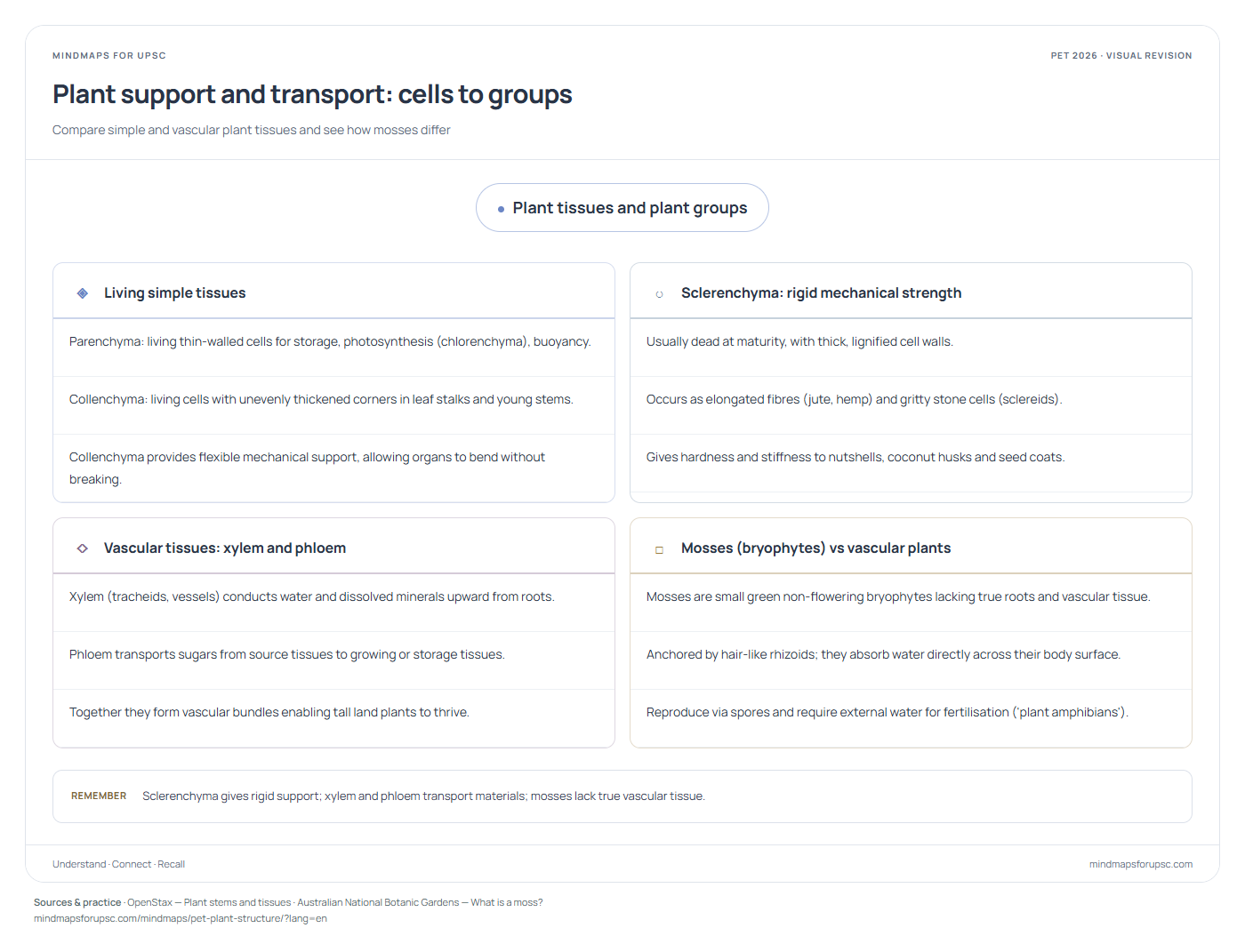
Plant tissues and plant groups
◈
Living simple tissues
- Parenchyma: living thin-walled cells for storage, photosynthesis (chlorenchyma), buoyancy.
- Collenchyma: living cells with unevenly thickened corners in leaf stalks and young stems.
- Collenchyma provides flexible mechanical support, allowing organs to bend without breaking.
○
Sclerenchyma: rigid mechanical strength
- Usually dead at maturity, with thick, lignified cell walls.
- Occurs as elongated fibres (jute, hemp) and gritty stone cells (sclereids).
- Gives hardness and stiffness to nutshells, coconut husks and seed coats.
◇
Vascular tissues: xylem and phloem
- Xylem (tracheids, vessels) conducts water and dissolved minerals upward from roots.
- Phloem transports sugars from source tissues to growing or storage tissues.
- Together they form vascular bundles enabling tall land plants to thrive.
□
Mosses (bryophytes) vs vascular plants
- Mosses are small green non-flowering bryophytes lacking true roots and vascular tissue.
- Anchored by hair-like rhizoids; they absorb water directly across their body surface.
- Reproduce via spores and require external water for fertilisation ('plant amphibians').
पादप ऊतक और पादप समूह
◈
जीवित सरल स्थायी ऊतक
- पैरेंकाइमा (मृदूतक): पतली भित्ति वाली जीवित कोशिकाएँ जो भोजन संचय, प्रकाश-संश्लेषण और जलीय पौधों में उत्प्लावन (ऐरेंकाइमा) देती हैं।
- कॉलेंकाइमा (स्थूलकोणोतक): पर्णवृंत और कोमल तनों में पाई जाने वाली जीवित कोशिकाएँ जिनके कोने असमान रूप से मोटे होते हैं।
- कॉलेंकाइमा पौधों के कोमल भागों को लचीलापन और यांत्रिक सहारा देता है, जिससे वे बिना टूटे मुड़ सकते हैं।
○
स्क्लेरेंकाइमा (दृढ़ोतक): कठोर यांत्रिक मज़बूती
- परिपक्वता पर सामान्यतः मृत; कोशिका-भित्तियाँ मोटी और लिग्निनयुक्त होती हैं।
- यह दो रूपों में मिलता है—लंबे रेशे (जैसे जूट, सन) और कठोर दृढ़ कोशिकाएँ (स्क्लेरीड्स/स्टोन सेल्स)।
- यह मेवे (नट/अखरोट) के छिलकों, नारियल के रेशेदार छिलके और बीजावरण को कठोरता व यांत्रिक मज़बूती प्रदान करता है।
◇
जटिल संवहन ऊतक: ज़ाइलम और फ्लोएम
- ज़ाइलम (वाहिनिकाएँ, वाहिकाएँ) जड़ों से जल और खनिज लवणों का ऊपर की ओर एकदिशीय संवहन करता है।
- फ्लोएम शर्करा को स्रोत ऊतकों से बढ़ते या संचय करने वाले ऊतकों तक पहुँचाता है।
- ज़ाइलम और फ्लोएम मिलकर संवहन बंडल बनाते हैं, जो बड़े स्थलीय पौधों के खड़े रहने और पोषण का आधार हैं।
□
मॉस (ब्रायोफाइटा) बनाम संवहनी पौधे
- मॉस (Moss) ब्रायोफाइटा समूह के छोटे हरे पौधे हैं जिनमें फूल, बीज, संवहन ऊतक और वास्तविक जड़ें नहीं होतीं।
- ये वास्तविक जड़ों के बजाय रोम-सदृश 'मूलाभास' (Rhizoids) से टिके रहते हैं और सतह से सीधे जल सोखते हैं।
- ये बीजाणुओं (Spores) से प्रजनन करते हैं और निषेचन हेतु जल आवश्यक होने से 'पादप जगत के उभयचर' कहलाते हैं।
Practise this concept · संबंधित प्रश्न
One visual, several questions. These links open the original paper at the matching question.
Sources & study notes · स्रोत
Independent revision material, linked to the paper’s concepts. The question papers and answer-key status are available on OpenPYQ.