PET 2026 · Geography
From pressure and uplift to rainfallवायुदाब और आरोहण से वर्षा तक का चक्र
How solar heating, convergence and terrain drive the precipitation cycleसौर तापन, पवन अभिसरण और उच्चावच से संचालित होने वाला वर्षा चक्र
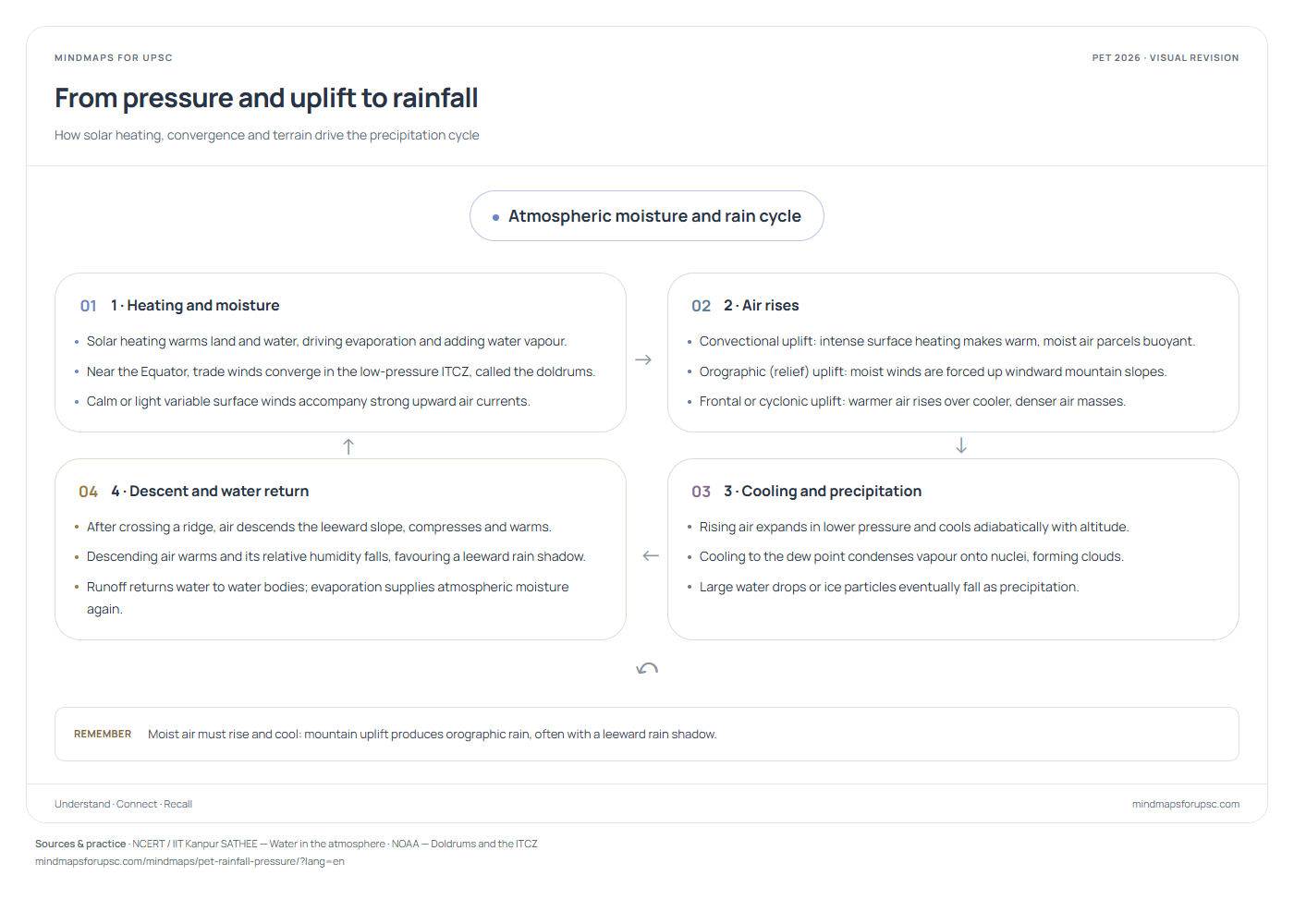
Atmospheric moisture and rain cycle
-
01
1 · Heating and moisture
- Solar heating warms land and water, driving evaporation and adding water vapour.
- Near the Equator, trade winds converge in the low-pressure ITCZ, called the doldrums.
- Calm or light variable surface winds accompany strong upward air currents.
-
02
2 · Air rises
- Convectional uplift: intense surface heating makes warm, moist air parcels buoyant.
- Orographic (relief) uplift: moist winds are forced up windward mountain slopes.
- Frontal or cyclonic uplift: warmer air rises over cooler, denser air masses.
-
03
3 · Cooling and precipitation
- Rising air expands in lower pressure and cools adiabatically with altitude.
- Cooling to the dew point condenses vapour onto nuclei, forming clouds.
- Large water drops or ice particles eventually fall as precipitation.
-
04
4 · Descent and water return
- After crossing a ridge, air descends the leeward slope, compresses and warms.
- Descending air warms and its relative humidity falls, favouring a leeward rain shadow.
- Runoff returns water to water bodies; evaporation supplies atmospheric moisture again.
↶
वायुमंडलीय आर्द्रता और वर्षा चक्र
-
01
1 · तापन और नमी
- सौर तापन से जल और थल गर्म होते हैं, जिससे वाष्पीकरण होता है और वायु में जलवाष्प जुड़ती है।
- भूमध्य रेखा के पास व्यापारिक पवनें निम्न-दाब पेटी (ITCZ) में मिलती हैं, जिसे 'डोलड्रम' (शांत पेटी) कहते हैं।
- यहाँ धरातल पर पवनें प्रायः शांत या मंद रहती हैं, किंतु प्रबल ऊर्ध्वाधर वायु धाराएँ ऊपर उठती हैं।
-
02
2 · वायु उठती है
- संवहनी आरोहण: तीव्र धरातलीय तापन से गर्म और आर्द्र वायु हल्की होकर ऊपर उठती है।
- पर्वतीय (उच्चावच/रिलीफ) आरोहण: आर्द्र पवनें पर्वत के पवनमुखी ढाल के सहारे ऊपर उठने को बाध्य होती हैं।
- वाताग्री या चक्रवाती आरोहण: गर्म वायुराशि ठंडी और सघन वायुराशि के ऊपर चढ़ती है।
-
03
3 · शीतलन और वर्षण
- ऊपर उठती हुई वायु कम वायुदाब के कारण फैलती है और रुद्धोष्म (एडियाबेटिक) रूप से ठंडी होती है।
- ओसांक तक ठंडा होने पर जलवाष्प सूक्ष्म कणों पर संघनित होकर बादलों का निर्माण करती है।
- बड़े जलकण या हिमकण अंततः वर्षण के रूप में नीचे गिरते हैं।
-
04
4 · अवरोहण और जल की वापसी
- पर्वत शिखर पार करने के बाद वायु पवनविमुख ढाल पर नीचे उतरती है तथा संपीडित होकर गर्म होती है।
- उतरती वायु गर्म होती है और उसकी सापेक्षिक आर्द्रता घटती है; पवनविमुख भाग में वृष्टि-छाया बन सकती है।
- अपवाह जल को जलाशयों तक लौटाता है; वाष्पीकरण फिर वायुमंडल को नमी देता है।
↶
Practise this concept · संबंधित प्रश्न
One visual, several questions. These links open the original paper at the matching question.
Sources & study notes · स्रोत
Independent revision material, linked to the paper’s concepts. The question papers and answer-key status are available on OpenPYQ.