PET 2026 · CSAT
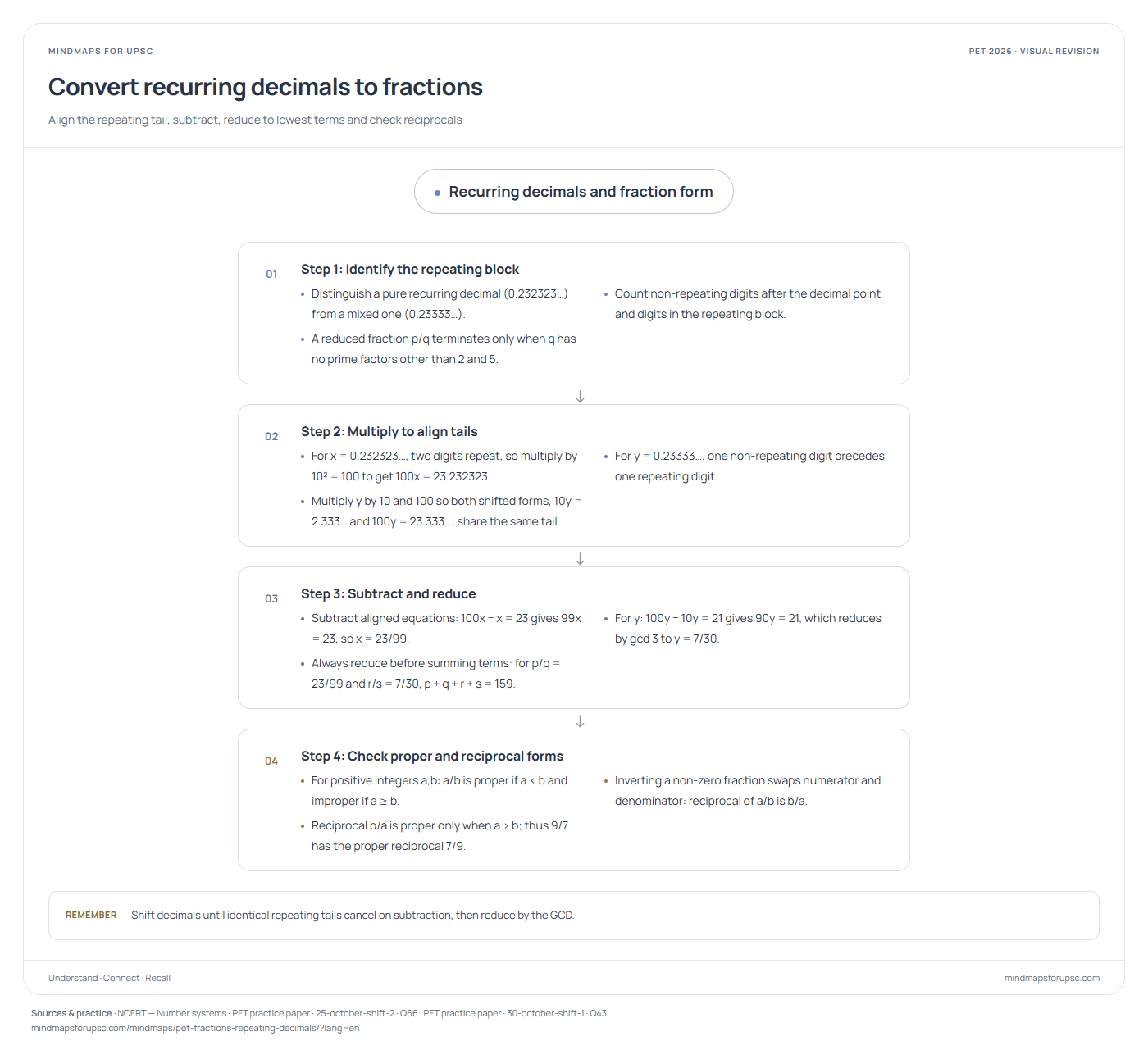
Convert recurring decimals to fractions आवर्ती दशमलवों को भिन्न में बदलना Align the repeating tail, subtract, reduce to lowest terms and check reciprocals आवर्ती भाग को संरेखित करें, घटाएँ, सरलतम रूप में लाएँ और व्युत्क्रम जाँचें
01
Step 1: Identify the repeating block
Distinguish a pure recurring decimal (0.232323…) from a mixed one (0.23333…). Count non-repeating digits after the decimal point and digits in the repeating block. A reduced fraction p/q terminates only when q has no prime factors other than 2 and 5.
02
Step 2: Multiply to align tails
For x = 0.232323…, two digits repeat, so multiply by 10² = 100 to get 100x = 23.232323… For y = 0.23333…, one non-repeating digit precedes one repeating digit. Multiply y by 10 and 100 so both shifted forms, 10y = 2.333… and 100y = 23.333…, share the same tail.
03
Step 3: Subtract and reduce
Subtract aligned equations: 100x − x = 23 gives 99x = 23, so x = 23/99. For y: 100y − 10y = 21 gives 90y = 21, which reduces by gcd 3 to y = 7/30. Always reduce before summing terms: for p/q = 23/99 and r/s = 7/30, p + q + r + s = 159.
04
Step 4: Check proper and reciprocal forms
For positive integers a,b: a/b is proper if a < b and improper if a ≥ b. Inverting a non-zero fraction swaps numerator and denominator: reciprocal of a/b is b/a. Reciprocal b/a is proper only when a > b; thus 9/7 has the proper reciprocal 7/9. Remember Shift decimals until identical repeating tails cancel on subtraction, then reduce by the GCD.
01
चरण 1: आवर्ती खंड की पहचान
शुद्ध आवर्ती दशमलव (0.232323…) और मिश्रित आवर्ती दशमलव (0.23333…) में अंतर करें। दशमलव बिंदु के बाद अनावर्ती अंकों और आवर्ती खंड के अंकों की संख्या गिनें। सरलतम भिन्न p/q का दशमलव प्रसार तभी सांत होता है जब q के अभाज्य गुणनखंड केवल 2 या 5 हों।
02
चरण 2: आवर्ती भाग संरेखित करना
x = 0.232323… में दो अंक दोहराते हैं, अतः 10² = 100 से गुणा कर 100x = 23.232323… प्राप्त करें। y = 0.23333… में एक अनावर्ती अंक के बाद एक आवर्ती अंक आता है। y को 10 और 100 से गुणा करें ताकि 10y = 2.333… और 100y = 23.333… के आवर्ती भाग समान हो जाएँ।
03
चरण 3: घटाना और सरलतम रूप
संरेखित समीकरण घटाएँ: 100x − x = 23 से 99x = 23, अर्थात् x = 23/99 मिलता है। y के लिए: 100y − 10y = 21 से 90y = 21 मिलता है, जिसे म.स.प. 3 से काटने पर y = 7/30 आता है। पदों को जोड़ने से पहले भिन्न को न्यूनतम रूप में लाएँ: p/q = 23/99 व r/s = 7/30 से p + q + r + s = 159।
04
चरण 4: उचित भिन्न और व्युत्क्रम जाँच
धनात्मक पूर्णांकों a,b के लिए a/b उचित है यदि a < b, और अनुचित है यदि a ≥ b। अशून्य भिन्न का व्युत्क्रम अंश और हर को बदल देता है: a/b का व्युत्क्रम b/a है। व्युत्क्रम b/a तभी उचित भिन्न होगा जब a > b हो; अतः 9/7 का व्युत्क्रम 7/9 एक उचित भिन्न है। याद रखें दशमलव को ऐसे खिसकाएँ कि घटाने पर समान आवर्ती भाग कट जाए, फिर म.स.प. से सरलतम रूप में लाएँ।
Practise this concept · संबंधित प्रश्न One visual, several questions. These links open the original paper at the matching question.
Sources & study notes · स्रोत Independent revision material, linked to the paper’s concepts. The question papers and answer-key status are available on OpenPYQ.