◈
Prime factorisation first
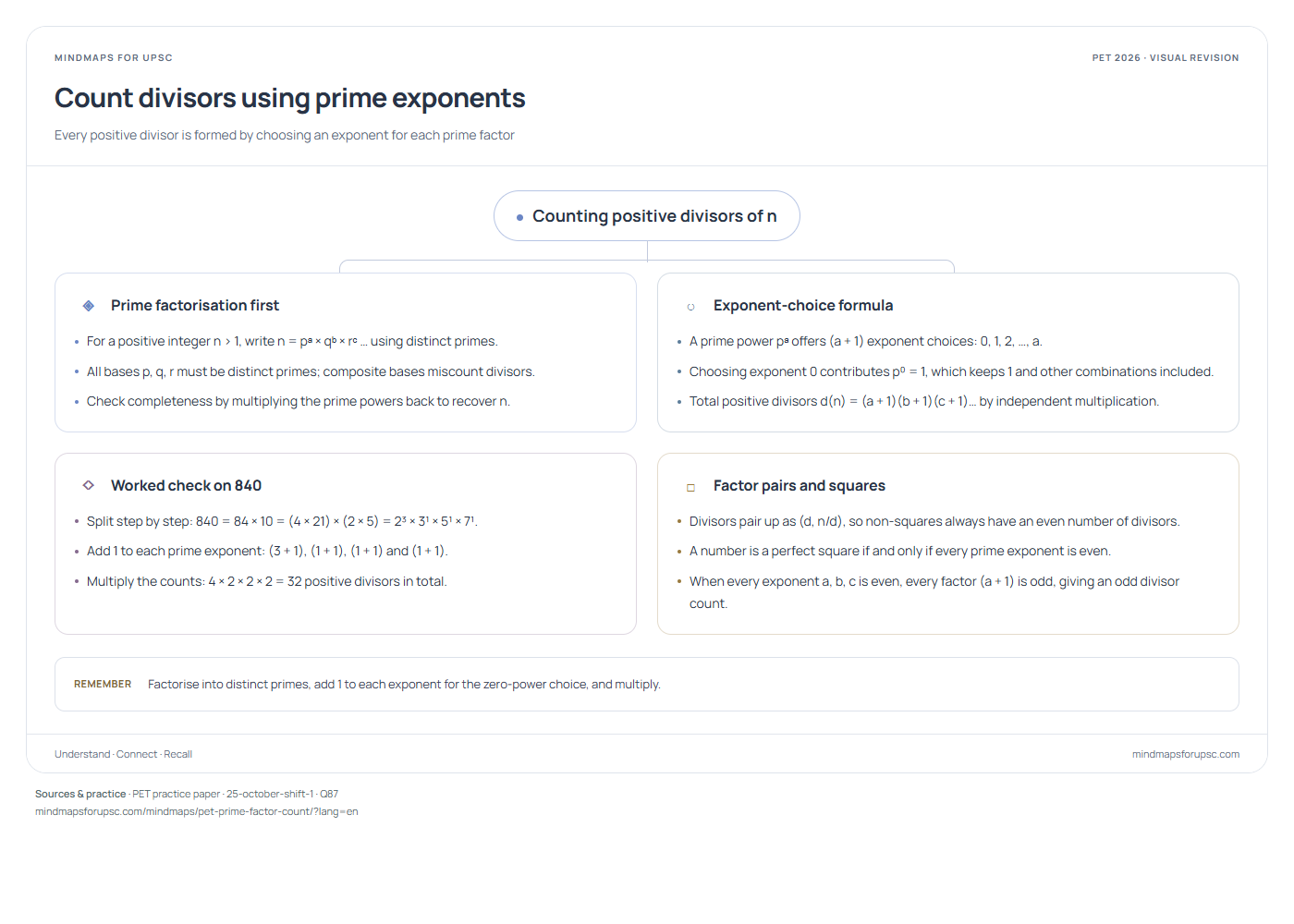
For a positive integer n > 1, write n = pᵃ × qᵇ × rᶜ … using distinct primes. All bases p, q, r must be distinct primes; composite bases miscount divisors. Check completeness by multiplying the prime powers back to recover n.
○
Exponent-choice formula
A prime power pᵃ offers (a + 1) exponent choices: 0, 1, 2, …, a. Choosing exponent 0 contributes p⁰ = 1, which keeps 1 and other combinations included. Total positive divisors d(n) = (a + 1)(b + 1)(c + 1)… by independent multiplication.
◇
Worked check on 840
Split step by step: 840 = 84 × 10 = (4 × 21) × (2 × 5) = 2³ × 3¹ × 5¹ × 7¹. Add 1 to each prime exponent: (3 + 1), (1 + 1), (1 + 1) and (1 + 1). Multiply the counts: 4 × 2 × 2 × 2 = 32 positive divisors in total.
□
Factor pairs and squares
Divisors pair up as (d, n/d), so non-squares always have an even number of divisors. A number is a perfect square if and only if every prime exponent is even. When every exponent a, b, c is even, every factor (a + 1) is odd, giving an odd divisor count. Remember Factorise into distinct primes, add 1 to each exponent for the zero-power choice, and multiply.
◈
पहले अभाज्य गुणनखंडन
धनात्मक पूर्णांक n > 1 को भिन्न अभाज्यों से n = pᵃ × qᵇ × rᶜ … लिखें। सभी आधार p, q, r भिन्न अभाज्य संख्याएँ होने चाहिए; भाज्य आधारों से गणना गलत होती है। अभाज्य घातों को पुनः गुणा करके पुष्टि करें कि गुणनफल वापस n ही आता है।
○
घातांक-चयन सूत्र
अभाज्य घात pᵃ के लिए 0, 1, 2, …, a तक कुल (a + 1) घातांक विकल्प होते हैं। घातांक 0 चुनने पर p⁰ = 1 मिलता है, जिससे 1 और अन्य सभी संयोजन शामिल रहते हैं। स्वतंत्र गुणन नियम से कुल धनात्मक भाजक d(n) = (a + 1)(b + 1)(c + 1)… होते हैं।
◇
840 पर सत्यापित उदाहरण
क्रमशः तोड़ें: 840 = 84 × 10 = (4 × 21) × (2 × 5) = 2³ × 3¹ × 5¹ × 7¹। प्रत्येक अभाज्य घातांक में 1 जोड़ें: (3 + 1), (1 + 1), (1 + 1) और (1 + 1)। विकल्पों का गुणा करें: 4 × 2 × 2 × 2 = कुल 32 धनात्मक भाजक।
□
भाजक युग्म और पूर्ण वर्ग
भाजक (d, n/d) के युग्म बनाते हैं, इसलिए अपूर्ण वर्ग संख्याओं के भाजकों की संख्या सदैव सम होती है। कोई संख्या पूर्ण वर्ग तभी होती है जब उसका प्रत्येक अभाज्य घातांक सम हो। जब सभी घातांक a, b, c सम हों, तो प्रत्येक (a + 1) विषम होता है और कुल भाजक विषम संख्या में मिलते हैं। याद रखें भिन्न अभाज्य संख्याओं में गुणनखंड करें, शून्य-घात विकल्प हेतु प्रत्येक घातांक में 1 जोड़ें और गुणा करें।
Practise this concept · संबंधित प्रश्न One visual, several questions. These links open the original paper at the matching question.
Sources & study notes · स्रोत Independent revision material, linked to the paper’s concepts. The question papers and answer-key status are available on OpenPYQ.